A family trailer designed before the first weld: kitchen, gear box, three bikes
A brief dictated in one sentence, a parametric 3D model, and calculations that sent my Mini axle back to the back of the garage
Two minutes, if you want to build a trailer yourself
- The project: a trailer behind our long-wheelbase T5. On the ground floor, a drawer kitchen (sink, stove) on one side and the fridge with its gas bottle on the other; above it, a large box for climbing, surfing and hiking gear; on the roof, the family’s three bikes.
- The method: draw and calculate everything before buying a single tube. The model is a parametric Blender script: change a dimension, rerun, get new pictures.
- The bad news: the Mini axle I had planned on can’t carry the load. Fully loaded, the trailer puts about 540 kg on the axle, against roughly 450 allowed. See The Mini axle failed the numbers.
- The good news: the Seat Cordoba 1.9D axle I also have at hand carries far more. The first version of this post claimed its coil springs cost no height: that was wrong, they rise up towards the body. Since 21 September the problem has come down to a single dimension to measure. See Correction: the springs do take up room, then The Cordoba, down to one dimension.
- On the motorway, snaking isn’t the issue — a T5 weighs four times the trailer. The real risk is crosswind — and it’s the bikes, not the body: on the way home, a 55 km/h gust is enough to unload a wheel when driving at 110 km/h. Figures redone on 21 September with the method used to close bridges to lorries. See Wind: three objections, then the bridge method.
- For easy reversing: a 2 m drawbar, and above all a single beam for the first metre behind the ball. That, more than the length, keeps the trailer from hitting the T5 when manoeuvring. See A drawbar you can reverse without thinking.
- The bikes don’t go up a ramp (it would have been 4.40 m long) but with a removable mast, a swivelling jib and a pulley. See Lifting three bikes to almost 2 m. Dropped on 21 September: the bikes no longer go up at all.
- Updates, 21 September: the wind calculation redone with the bridge method and the Mini axle coming back as a pair (first update), then two ideas that change the trailer’s shape: the axle sunk into the body and the bikes taken off the roof. The chosen version is 1.63 m tall instead of 2.92, and the gust it withstands at 110 km/h goes from 55 to 91 km/h. See the second update.
Nothing is built yet. This post is about the phase where anything you break only costs computing time.
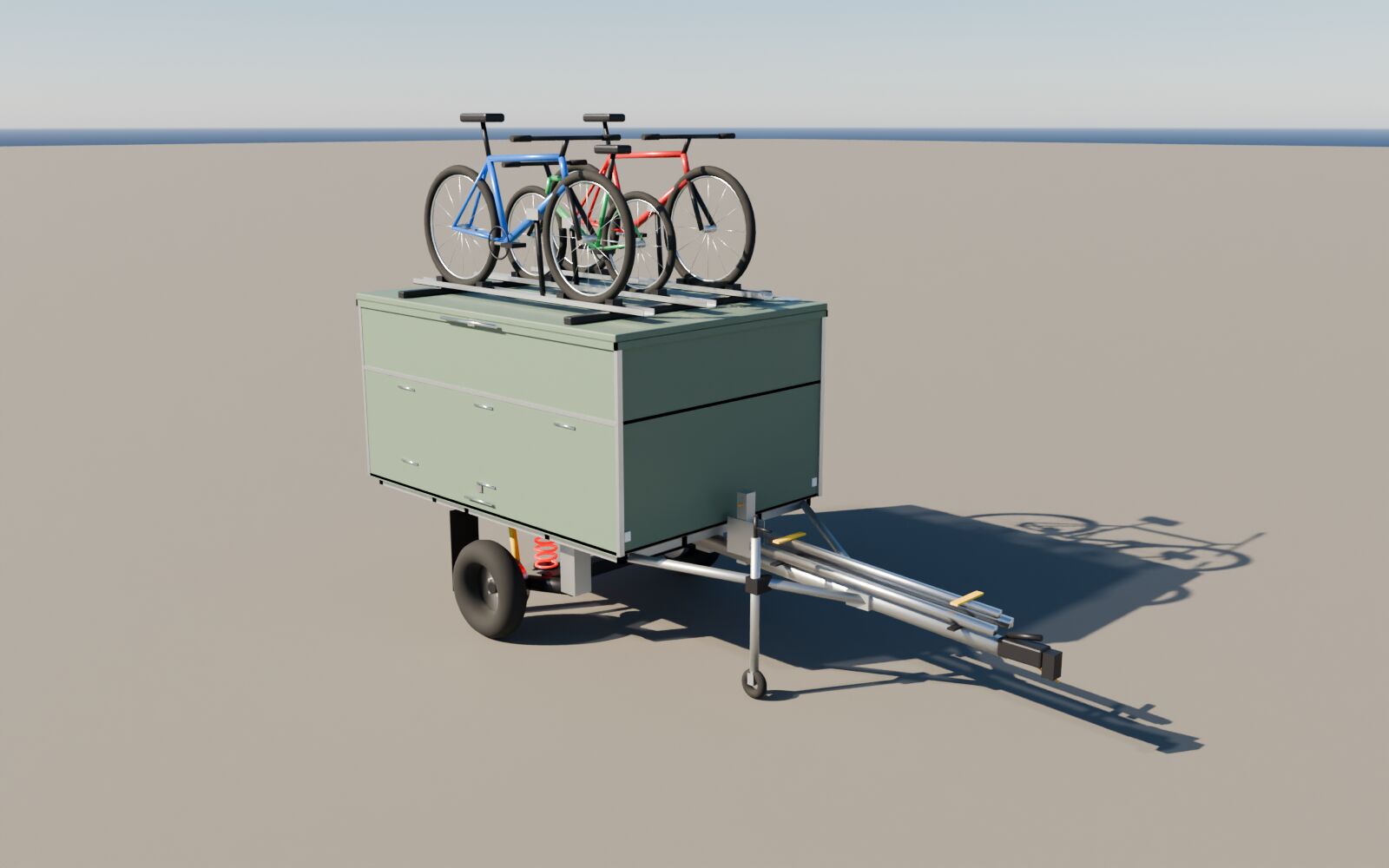
The 19 September version, closed, bikes loaded. Cordoba axle, 2.30 × 1.61 m body, 2 m drawbar with the lifting mast dismantled and laid on it. The one I finally chose is further down: it is 1.30 m lower.
The brief fits in one sentence
When we go climbing, surfing or hiking as a family, the T5 fills up fast. The idea: take everything bulky out of the cabin — kitchen, fridge, gear, bikes — and put it in a trailer designed for it, where everything has its place and opens without unpacking the rest.
I described it in one go, roughly like this: a Mini axle; on level zero, kitchen drawers on one side (sink and small stove), the fridge and its gas bottle on the other; on the level above, a large box for climbing gear, surfboards and walking poles, closed by a lid on boot hinges held open by gas struts; and on top, three slots for our three bikes, loaded by a removable ramp stowed under the trailer.
An AI (Claude) turned that sentence into a 3D model: a Python script that builds the trailer piece by piece in Blender, with every dimension at the top of the file. I never opened Blender to draw it. I looked at the pictures, corrected, clarified — and it was precisely when we moved from pictures to numbers that the project changed.
Three floors, one per use
The principle is a chest of drawers: heavy things at the bottom, bulky things in the middle, light and voluminous things on top.
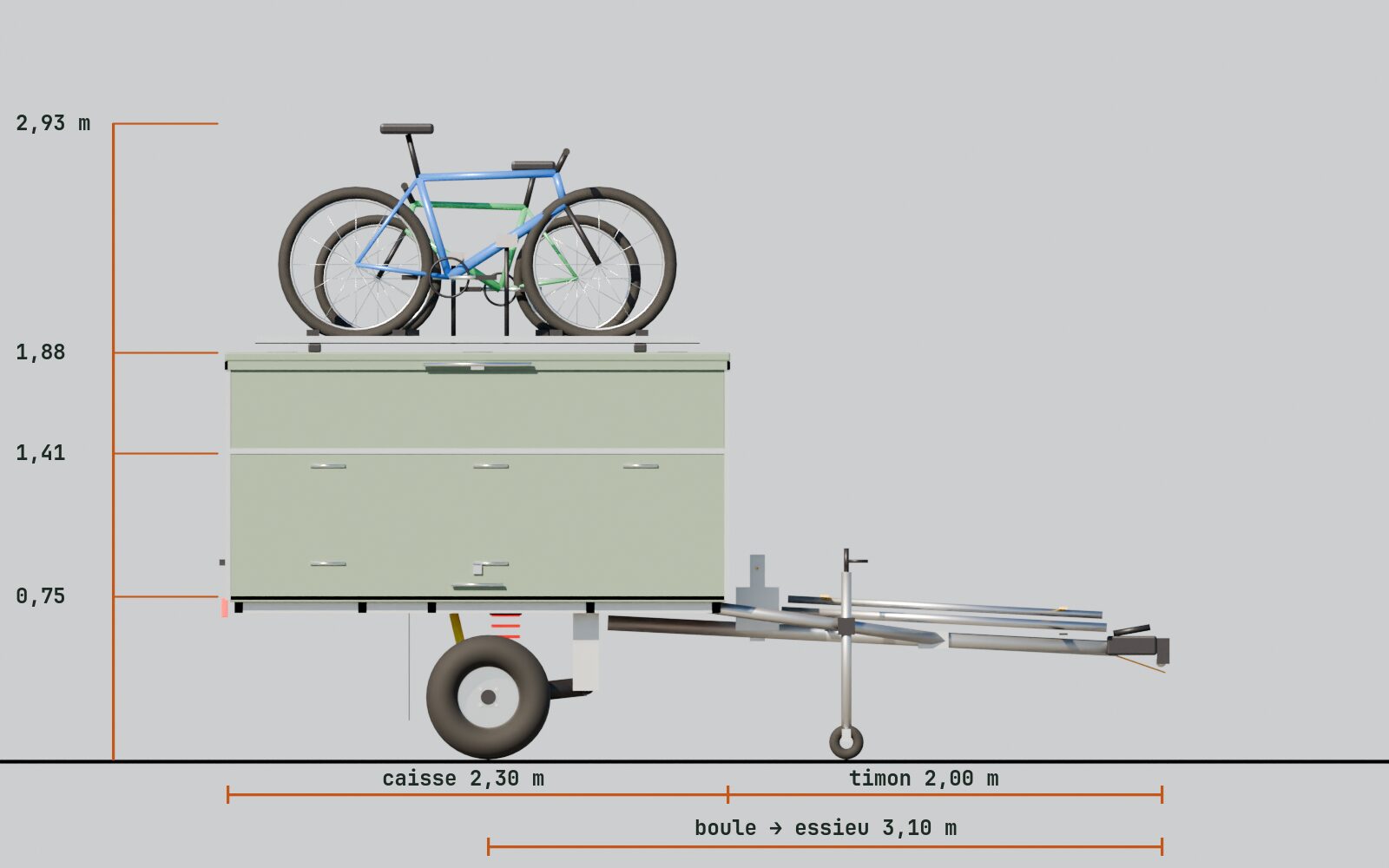
The main dimensions of the chosen version (the labels on the image use a decimal comma). The floor is high (0.75 m) because the body sits above the wheels: that is what allows a body wider than the track.
The ground floor, kerb side, is the kitchen. A flap lifts up and becomes an awning. Below it, two low drawers slide out: one carries the sink and its tap, the other a two-burner stove. Their top is the worktop, 0.95 m off the ground, standard kitchen height. That is no accident: the height of these drawers is derived from the floor height, which depends on the axle. Change the axle, the worktop stays at 0.95 m. Above, two drawers for dishes and groceries; at the end, a column for two 20 L jerrycans, a 12 V pump and the battery.
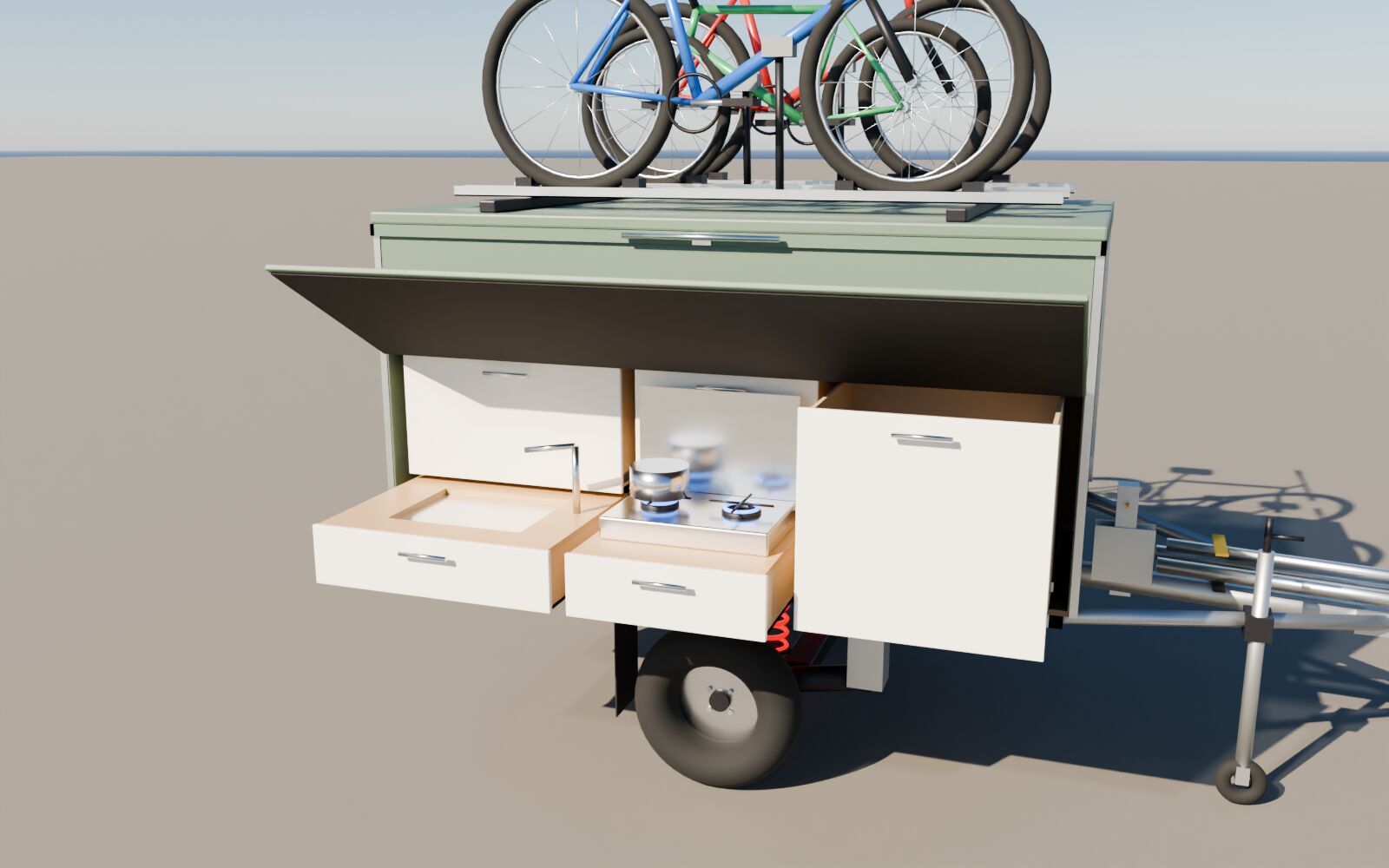
Kitchen side, bikes in place. Everything opens without unloading the roof.
On the other side, fridge and gas. A 40 L three-way fridge (12 V, 230 V, gas) on a pull-out slide, so it opens from the top once out. At the front, a locker sealed from the inside and vented to the outside — high and low grilles on the door, a grille in the floor, because propane is heavier than air — for a 6 kg bottle. At the back, the folding table and chairs.
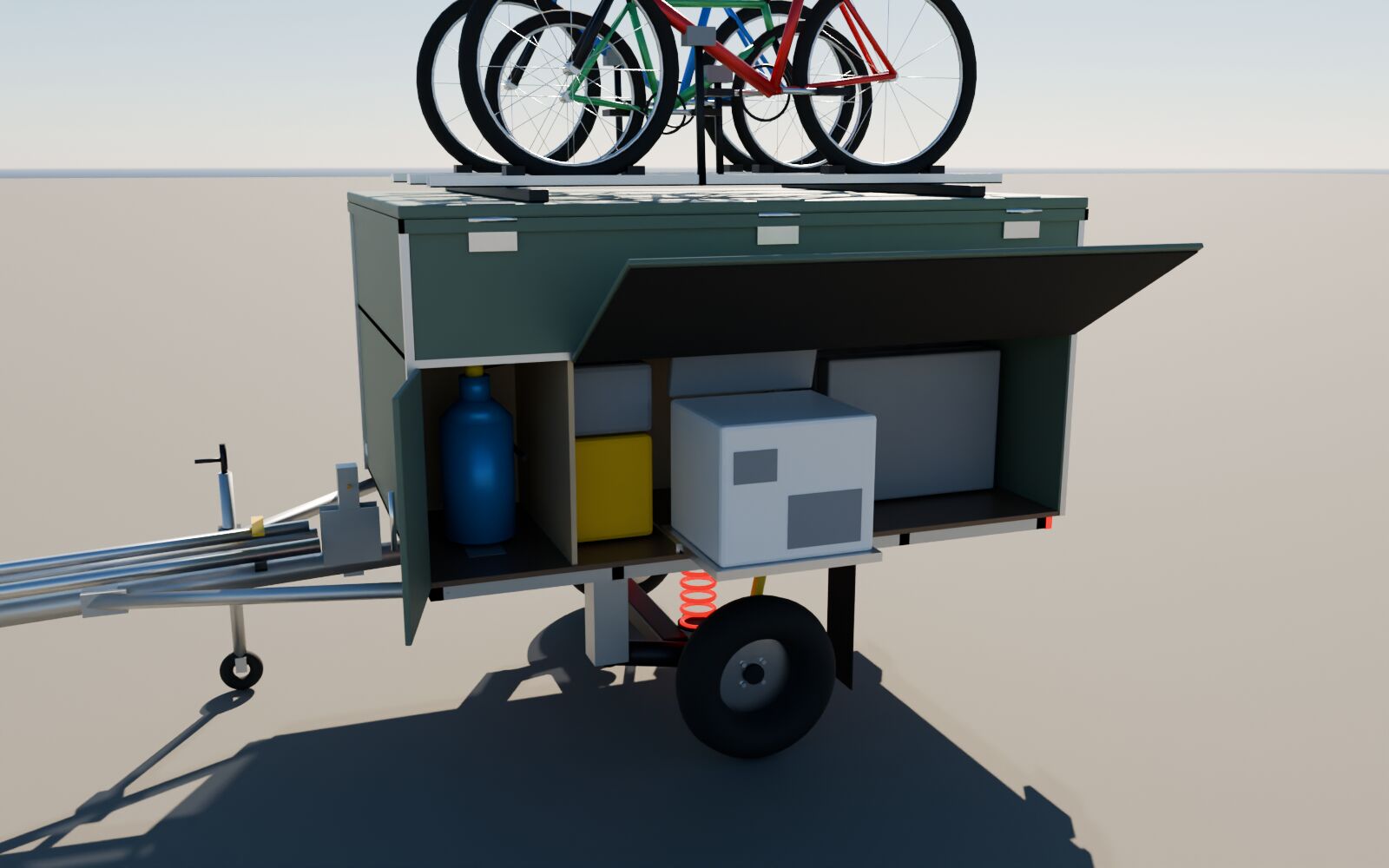
Fridge side. The bottle is separated from the rest by a bulkhead, with its own ventilation.
Above, the box. 2.26 m long inside: room to lay a 7‘0 surfboard, a crash pad, ropes, bags and poles. The lid pivots on three boot hinges and stays open at 82° on two gas struts.
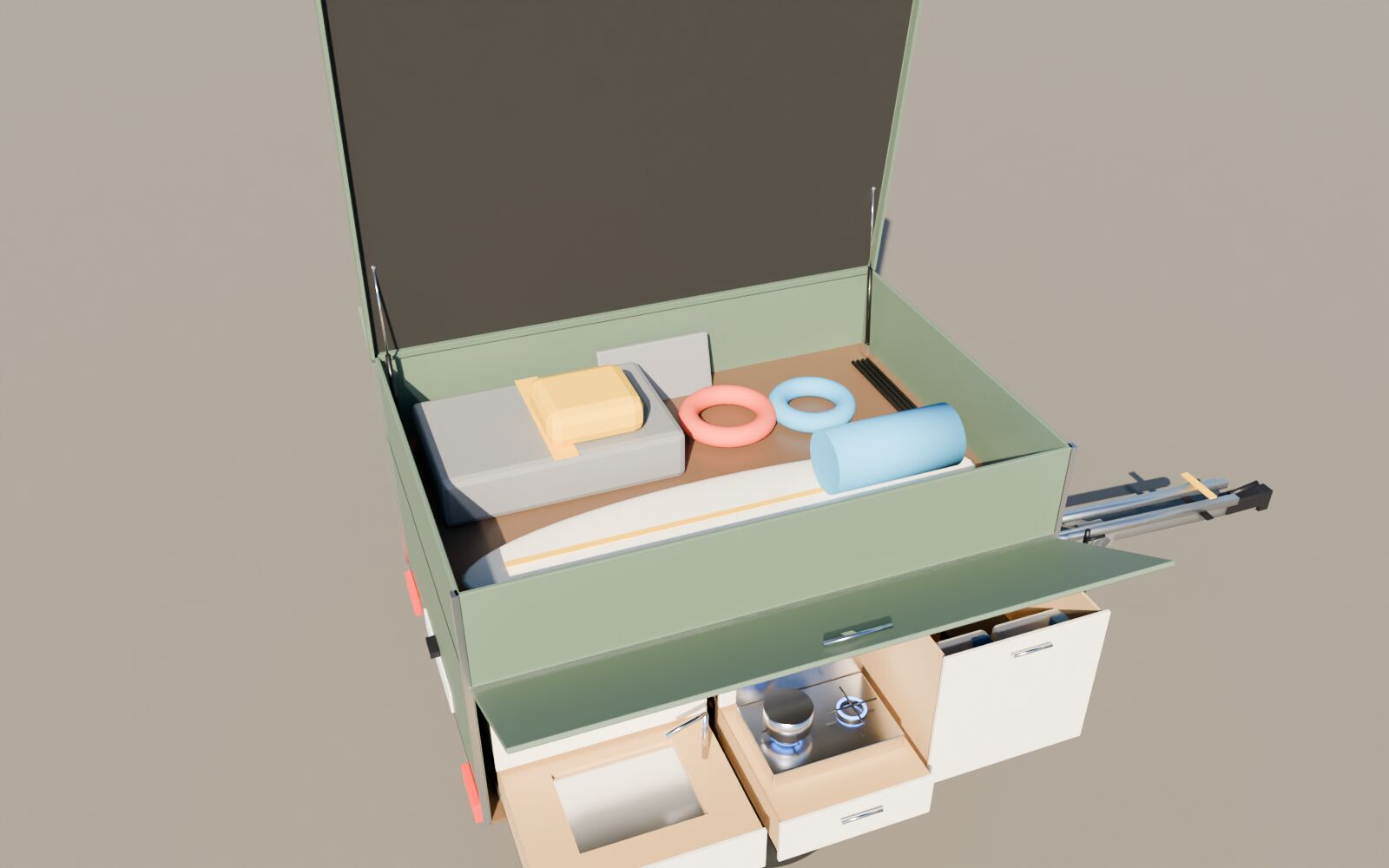
The open box, without the bikes — and that is not a staging choice.
It was the first thing the model taught me, before any calculation: the bikes sit on the lid. As long as they’re there, the box doesn’t open. The kitchen and fridge do. It’s a constraint to live with (load the box before the bikes) or to design around (a fixed rack on posts and side hatches), but not something to discover in the car park at the crag.
Update, 21 September: constraint lifted. The bikes have left the lid, and the box opens with the bikes loaded — see The bikes come down from the roof.
The first draft looked good and proved nothing
The first version produced clean pictures in one evening. Mini axle, 2.30 × 1.45 m body, 1.35 m drawbar, axle placed “a bit behind the middle to get some weight on the ball”, a four-section telescopic ramp for the bikes. Everything looked plausible.
And that is exactly the problem: a clean render looks like a validation. Nothing in those pictures said how much the trailer weighs, what the axle can carry, or how it behaves at 130 km/h behind a van. So I asked what a trailer builder would ask: a proper weight distribution, and a drawbar long enough to manoeuvre easily with my long T5.
The calculation is a second script, independent of Blender. It takes every component — frame, drawbar, panels, drawers, fridge, water, gas, gear, bikes — with its estimated mass and position, and derives the centre of gravity and the load on the ball and on the axle, for five loading cases: empty; loaded without bikes; loaded with bikes; on the way back, water and food used up; and with e-bikes.
First result: the trailer weighs 416 kg empty in its lightest version (50×30 tube frame, 15 mm poplar plywood). Loaded with the bikes, 582 kg. The very first ballpark estimate, made before this calculation, said 260 to 400 kg empty: the bottom of that range was very optimistic.
The Mini axle failed the numbers
My axle is the rear suspension of a classic Mini: a subframe, two trailing arms, rubber cones for springs, 10-inch wheels. It’s compact and light. It’s also the rear axle of a 650 kg car, normally carrying 250 to 300 kg — and something like 450 kg at most.
Loaded with the bikes, the trailer puts 541 kg on its axle; 563 kg with e-bikes. That’s 20 to 25% over what the subframe is meant to carry, permanently, on the motorway. Even stripping out everything that can be lightened, you don’t get under the limit with a kitchen, a fridge, 40 L of water and three bikes.
I had two other options at hand or within reach: a Peugeot 205 or 206 rear axle, and the one from a Seat Cordoba 1.9D (first generation). The calculation puts them all through the same test:
| Mini | 205 | 206 | Cordoba 1.9D | |
|---|---|---|---|---|
| Tyres | 145/80 R10 | 165/70 R13 | 175/65 R14 | 175/70 R13 |
| Track | 1.17 m | 1.30 m | 1.43 m | 1.40 m |
| Axle load, loaded + bikes | 541 kg | 568 kg | 586 kg | 584 kg |
| Max rear axle load (order of magnitude) | ~450 kg | ~600 kg | ~700 kg | ~750 kg |
| Lateral acceleration before rollover | 0.57 g | 0.60 g | 0.65 g | 0.64 g |
Maximum loads are orders of magnitude; the actual “rear axle” figure is on the donor car’s manufacturer plate.
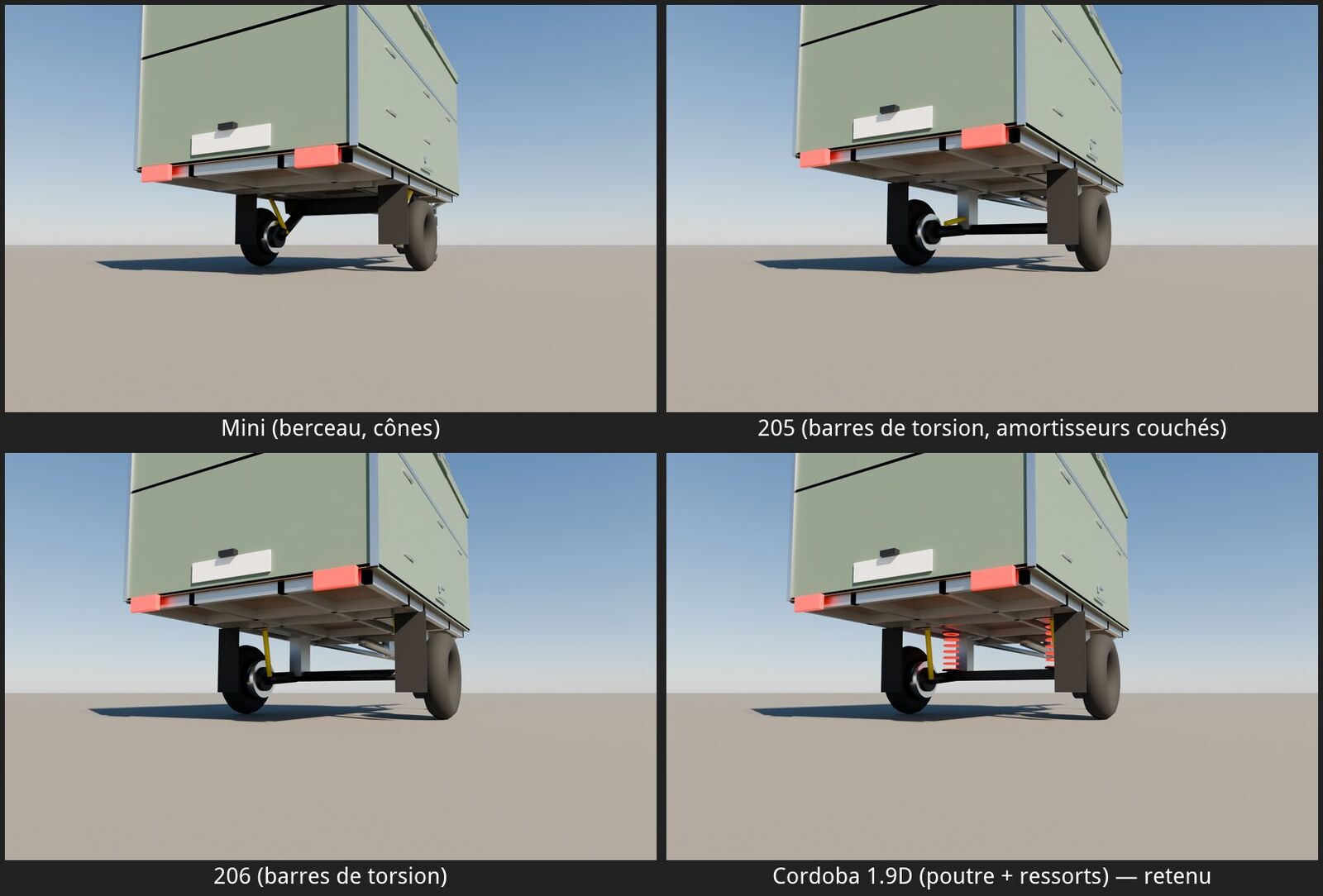
The same trailer on the four axles, generated by changing a single variable. The body widens by itself to cover the wheels. The Cordoba is drawn with separate springs sitting on the arms: that isn’t how the car does it (see the correction).
On paper, the Cordoba wins: the biggest load margin, 13-inch wheels that take potholes better and run their bearings cooler at 130, a wide track. And its suspension should work within its original range: the rear of a diesel Cordoba is designed for loads of the same order as the trailer’s (430 to 610 kg depending on the load). A bonus I hadn’t seen coming: on this kind of axle, the beam joining the two arms twists when one wheel rises and the other doesn’t — it acts as an anti-roll bar, exactly what you want with bikes perched up high.
Correction: the springs do take up room
Added on 19 September 2026, the day of publication.
The first version of this post said here that the Cordoba’s coil springs “don’t cost a single centimetre”: they would sit between the suspension arm and the underside of the frame, in the thirty-odd centimetres the tyre leaves free under the floor anyway. That’s what the render above shows, with its red springs.
Rereading it, something didn’t sit right: on the car, the spring rises up into the body, well above the wheel. A workshop guide for the Polo 6N, which shares its platform with the Cordoba 6K, confirms it. The spring wraps around the damper, the two form a single unit, and its top bolts into the boot, at the top of the wheel arch behind the trim. At the bottom, a horizontal eye bolts it to the beam, near the hub. The AI had reasoned about a separate spring sitting on the arm, as found on other axles of this type, without checking this particular car. And the clean render made the assumption look credible: exactly the trap described below.
The consequence: between the lower eye and the underside of the frame there are about 38 cm, and the unit is clearly longer. It would poke into level 0, right under the stove drawer on one side and the fridge on the other. Four ways out, not yet decided:
- separate spring and damper: keep the Cordoba’s beam and arms, sit the spring alone in a seat on the arm (bolted rather than welded, on a suspension part) and another under the frame, with a short damper mounted separately;
- turrets in level 0, rearranging the kitchen and the fridge side around the axle;
- raise the floor by the overhang: the simplest, but the bikes and the centre of gravity go up by the same amount, and crosswind is already the weak point;
- go back to the 205 axle, whose torsion bars sit inside the tube and whose dampers lie flat: no height problem at all, but a thin load margin with e-bikes.
To choose, I need three measurements on the axle: the length of the unit as fitted, the free length of the spring alone, and the height of the lower eye relative to the wheel centre.
Update, 21 September: the calculation has since reduced those three measurements to one. See The Cordoba, down to one dimension.
Holding the road behind the T5
The rule you hear everywhere: weight on the ball, or the trailer snakes. You still need to know how much. I aimed for 7% of the mass on the ball when fully loaded. The calculation then puts the axle 1.20 m from the back of the body — 5 cm ahead of the middle, where the first draft had put it 17 cm behind, by eye. Depending on the load, the nose weight stays between 5.8 and 7.6%, i.e. 31 to 45 kg, well below the 100 kg the T5’s tow bar accepts.
For snaking itself, the calculation uses a classic vehicle-dynamics model: car and trailer seen from above, joined by the ball, each with its mass, inertia and tyres that slip sideways. You look for the speed at which a small oscillation grows instead of dying out.
Result: above 400 km/h. In every loading case, on every axle, and even with the axle placed for zero or negative nose weight.
A result that comfortable makes me suspicious. A model that says “all good” whatever you give it may well be a model that computes nothing. So we tested it on a case whose answer is known: a 1.5 t caravan behind a 1.4 t saloon. The same model has it losing control at around 160 km/h with 5% nose weight, 110 km/h with 3%, 80 km/h with none — which matches what you read everywhere about caravans. So the model can predict instability; if it finds none here, it’s because the T5 weighs four times the trailer. The dog wags the tail, not the other way round.
The real risk is elsewhere, and much more mundane: crosswind. Three bikes nearly 3 m up, a 1.20 m high flank, a 1.40 m track. On the way back, with water and food used up, a 55 km/h crosswind gust is enough to unload the windward wheel when driving at 110 km/h; in a curve, about thirty. (Correction, 21 September: the first version said “about 100 km/h”. That figure came from a home-made model, and it only holds for a parked trailer. The story of this correction is told further down.) The rule follows: with strong wind forecast, drive slower, or the bikes travel in the T5.
A drawbar you can reverse without thinking
Reversing a short trailer is a test of nerves: it jackknifes before you understand why. What matters is the ratio of two lengths: the distance from the ball to the trailer axle, and from the T5’s rear axle to the ball (about 1.10 m on a long T5). The bigger the ratio, the slower the trailer reacts, and the more time you have to correct.
With a 2 m drawbar, the ball is 3.10 m from the axle: a ratio of 2.8. Going longer gains little (3.0 with a 2.20 m drawbar) and costs length (4.35 m overall, already 9.60 m for the whole rig with the T5).
Two calculation errors along the way were more instructive than the right answers. The first version announced that at full lock the trailer would sit at 164° to the T5 — in other words, overtaking it. A rotation in the wrong direction; once fixed, the angle drops to 51°. The second announced contact between trailer and T5 at 55°, whatever the drawbar length. Suspicious: if the length changes nothing, it isn’t what’s limiting. It was the coupling head itself, 25 cm from the ball — which in reality passes under the bumper, like on any trailer. With that point removed, the real limit showed up: how wide the V of the drawbar opens near the ball.
Hence the chosen shape: a single central beam for the first metre behind the ball, with the V opening only beyond it. First contact with the T5 then moves past 100° of articulation. At full lock, only 51 are used.
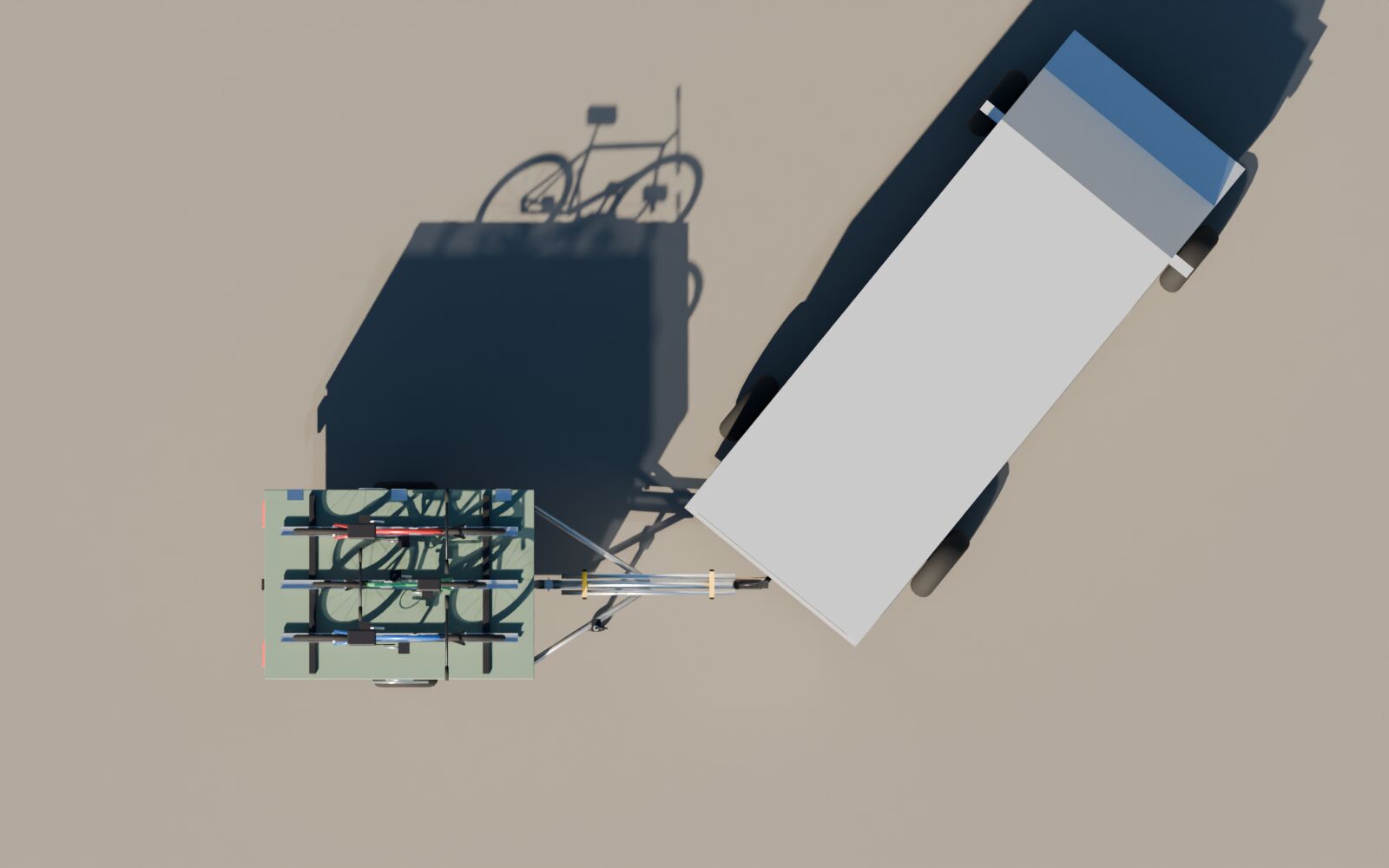
At full lock, steady state: 51° between T5 and trailer, with a good margin before any contact. The trailer cuts the corner about 1 m inside the path of the T5’s rear wheels.
A detail the model makes obvious and I wouldn’t have thought of: the trailer (1.61 m) is narrower than the T5 (1.90 m). Driving straight, you can’t see it in the mirrors. A wireless reversing camera, or two marker posts on the rear corners, are part of the project.
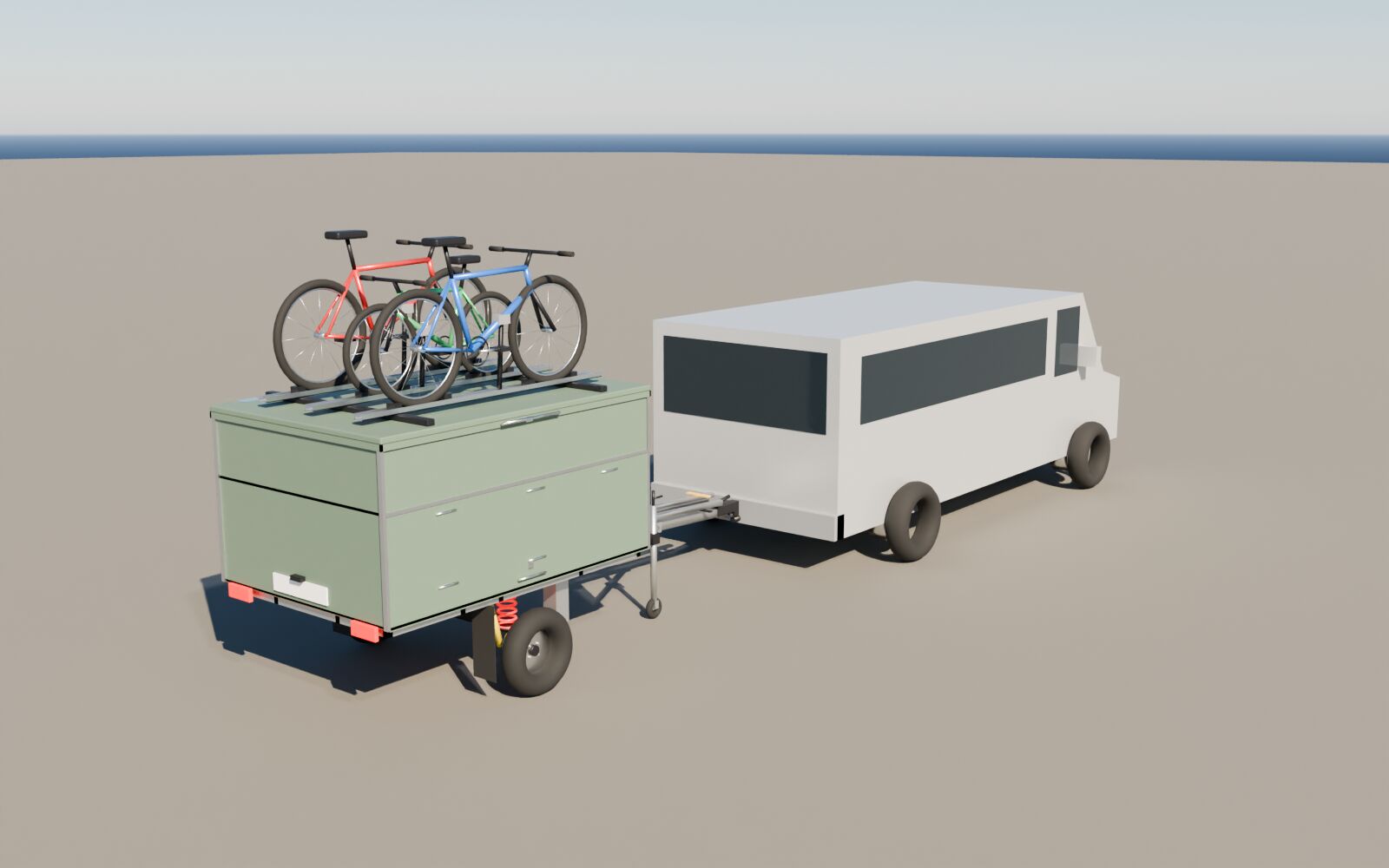
Hitched. The bikes stand a metre above the T5’s roof: worth remembering at car park height barriers.
Lifting three bikes to almost 2 m
Update, 21 September: this section describes a solution dropped two days later. I’m leaving it in, because the reasoning that kills the ramp still holds — and because the right answer was to stop lifting the bikes at all. See The bikes come down from the roof.
The ramp from my original idea died of simple trigonometry. The bikes sit at nearly 1.90 m; for a 25° slope, already steep for pushing a bike, you need a ramp over 4.40 m long — four telescopic sections, a prop in the middle so it doesn’t flex, and a 25 kg e-bike to push at arm’s length. Doable by two people with regular bikes, painful otherwise.
The alternative came from me, and it’s the one we kept: a removable mast, a jib that swivels at the top, a pulley at the end. The mast, two 1.50 m aluminium sections, slots into a sleeve welded onto the drawbar beam, just in front of the body. The jib, with a 1.45 m reach, covers all three rails plus a pick-up point on the ground beside the trailer. A hand winch on the mast, a cable over a pulley at the top then over the one at the end of the jib, and a spreader bar hooked to the bike’s saddle and stem so it goes up level.
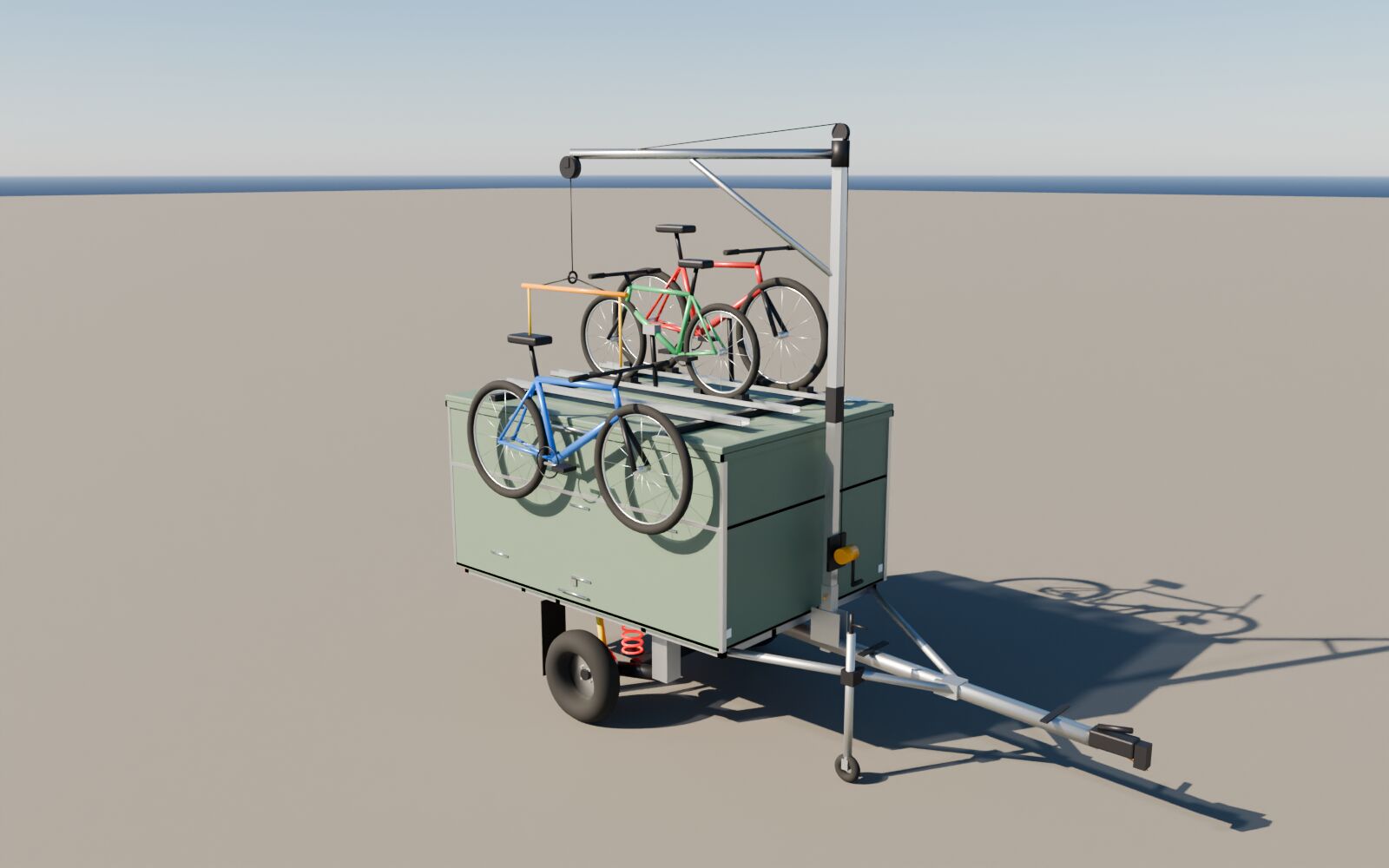
The right-hand bike being lifted. Dismantled, the mast and jib lie on the drawbar (visible in the other views).
Two constraints came out of the model. Height first: for a bike sitting in its rail to pass under the pulley, spreader bar included, the mast has to reach 3.45 m. And loading order: middle bike first. Otherwise you’d have to lift it over another one, and no reasonable mast goes that high. Finally, something better written down than assumed: you don’t lift anything on an unhitched, poorly chocked trailer.
Update, 21 September: the Mini comes back as a pair, and the wind goes via the library
Two days after publication. Nothing is built, so everything can still move — and it did.
What about two Mini axles?
After the post went out, someone put to me an idea I had dismissed too quickly: since one Mini subframe isn’t enough, fit two, one behind the other, with 5 cm wheel spacers. The case took one line: double the load, much better road holding, much more resistance to crosswind.
Adding the variant to the model took one line of parameters, like the other axles. What remained was to put a number on each claim.
- Load: true, and better than expected. Each subframe carries 290 kg, or 145 kg per wheel — about what a Mini’s rear wheel carries on the road. So each rubber cone works where it was designed to work. The margin goes from −25% with a single subframe to +33%, e-bikes included.
- Road holding: true, for a precise reason. Two axles 80 cm apart resist the trailer rotating about a vertical axis (yaw) far more than one does: the restoring effect of the tyres is multiplied by 4.7. That is what settles a trailer after a gust or a passing lorry.
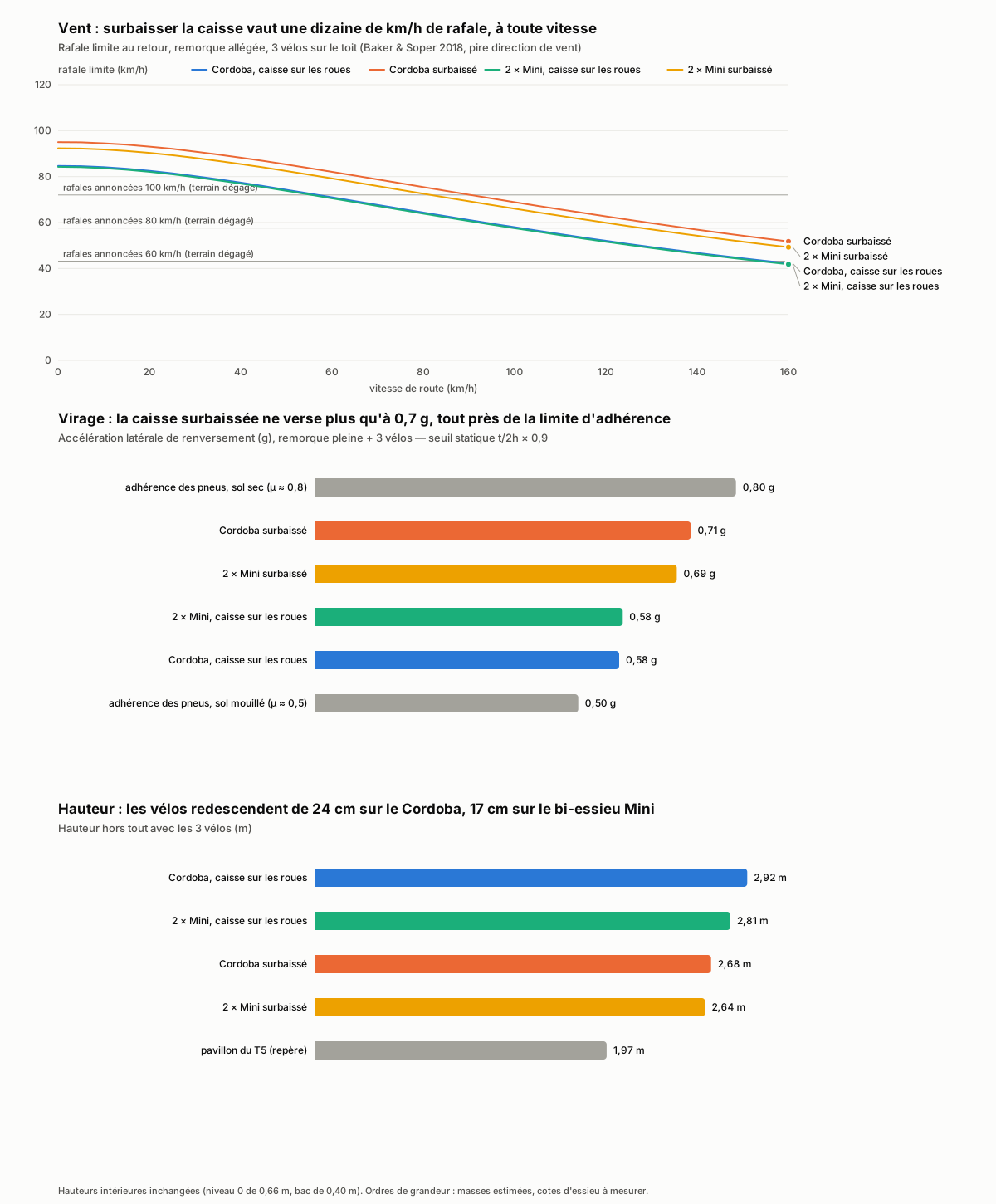
- Crosswind: a draw. Overturning depends on two things only, track width and centre-of-gravity height. The tandem gains because its 10-inch wheels allow a floor 11 cm lower, and loses as much because its track stays narrower than the Cordoba’s.
- “The load is doubled”: yes for the axle, no for the trailer. What caps the payload is the gross weight declared at approval: above 750 kg you need brakes and a different licence. The tandem buys margin and service life, not extra kilos to carry.
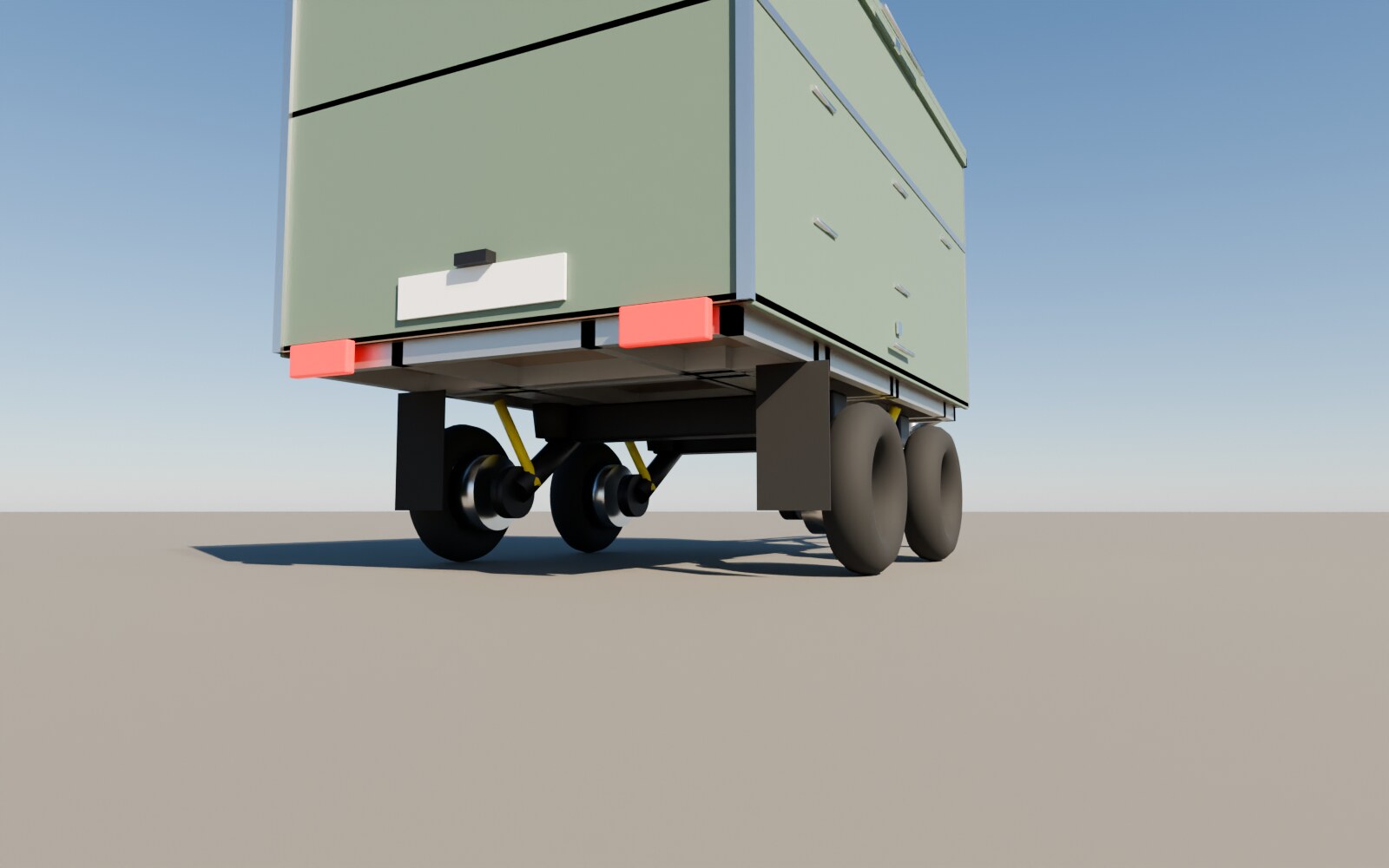
The twin Mini subframe variant. The rest of the model adapted by itself: 1.46 m wide body, floor at 0.64 m, bikes at 2.82 m instead of 2.93.
And it has a price. Tyre scrub, first: to pivot, a twin-axle trailer has to drag its tyres sideways. On full lock it takes 52 kg of side push at the tow ball. The T5 won’t notice; I will, the day I want to shift it by hand on a campsite pitch. Then a known flaw of this layout, which I found described by axle manufacturers: two independent suspensions don’t share the load by themselves. The height of the T5’s tow ball sets the trim — 5 cm off, and the front axle loses 51 kg while the rear takes on 39 — and over a bump a single axle takes almost everything. Manufacturers derate these axles by about 20% when fitting them in pairs; here each one works at 65% of its rating, so the rule is met. Finally, 43 kg more unladen weight, and five 10-inch tyres to find, a size that has become rare.
Wind: three objections, then the bridge method
The crosswind passage above was wrong. Not in its conclusion — the bikes on the roof remain the weak point — but in its numbers. The story of the correction taught me more than the correction itself.
The first calculation was a model hand-written by the AI: wind pushing on the trailer’s flank as on a panel. I balked three times.
“I’ve seen tall trailers with no suspension that don’t suffer from wind.” Checked: the same body without the bikes takes a much stronger gust. The problem isn’t the height of the body, it’s the bikes: perched at 2.30 m, they alone account for 41% of the effort trying to lay the trailer on its side. Along the way the model turned out to be too optimistic. It forgot that a moving trailer doesn’t get the wind from the side but from the front quarter, added to its own speed, and that a box taken at an angle is pushed much harder than a panel taken square-on.
“A bike isn’t a solid panel.” Correct. Counted part by part — tyres, rims, spokes, frame — a bike presents only 34% of its silhouette to the wind. And air passes through it: it suffers drag, not the wing effect the body suffers. The two downwind bikes are also sheltered by the first.
“You’re forgetting the T5 in front, clearing the way.” There I was surprised to be the one who thought of it. Answer: the T5 does shelter the trailer… in light wind. Its wake leaves with the wind, not along the road. At 110 km/h, the shelter is complete below 20 km/h of crosswind, half gone at 40, almost nil at 60. And the bikes stick out above its roof anyway.
Three corrections for three objections: we were groping. So I asked what I should have asked from the start — how do the people whose job this is do it? Ten minutes of searching were enough. The method exists, published and open access: Baker and Soper (2018), used to decide at what gust speed a bridge gets closed to lorries. It fits in three lines, it rests on coefficients measured in wind tunnels and at full scale, and it already contained my third objection: a trailer measured behind its lorry only gains about 10% of shelter.
Redone with that method, on the way home with bikes on the roof: a 55 km/h gust is enough to unload the windward wheel when driving at 110 km/h, 61 km/h when driving at 90. Trailer full, no bikes: 85. These are wind speeds at trailer height; forecasts give gusts measured 10 m up, and over open ground the wind is about a quarter weaker down at road level. The method ranks every vehicle by a “characteristic velocity”: with its bikes, my trailer is more vulnerable than an empty double-decker bus, the first vehicle to be stopped when the wind rises on the Queensferry Crossing in Scotland. The practical rule: from 80 km/h forecast gusts, slow to 90, or the bikes travel in the T5.
The home-made model gave 58 km/h instead of 55: the right order of magnitude, reached after three patches. One part of the calculation is still my own, and is flagged as such: the treatment of the bikes, for want of published measurements of bikes sitting on a roof.
When it lets go
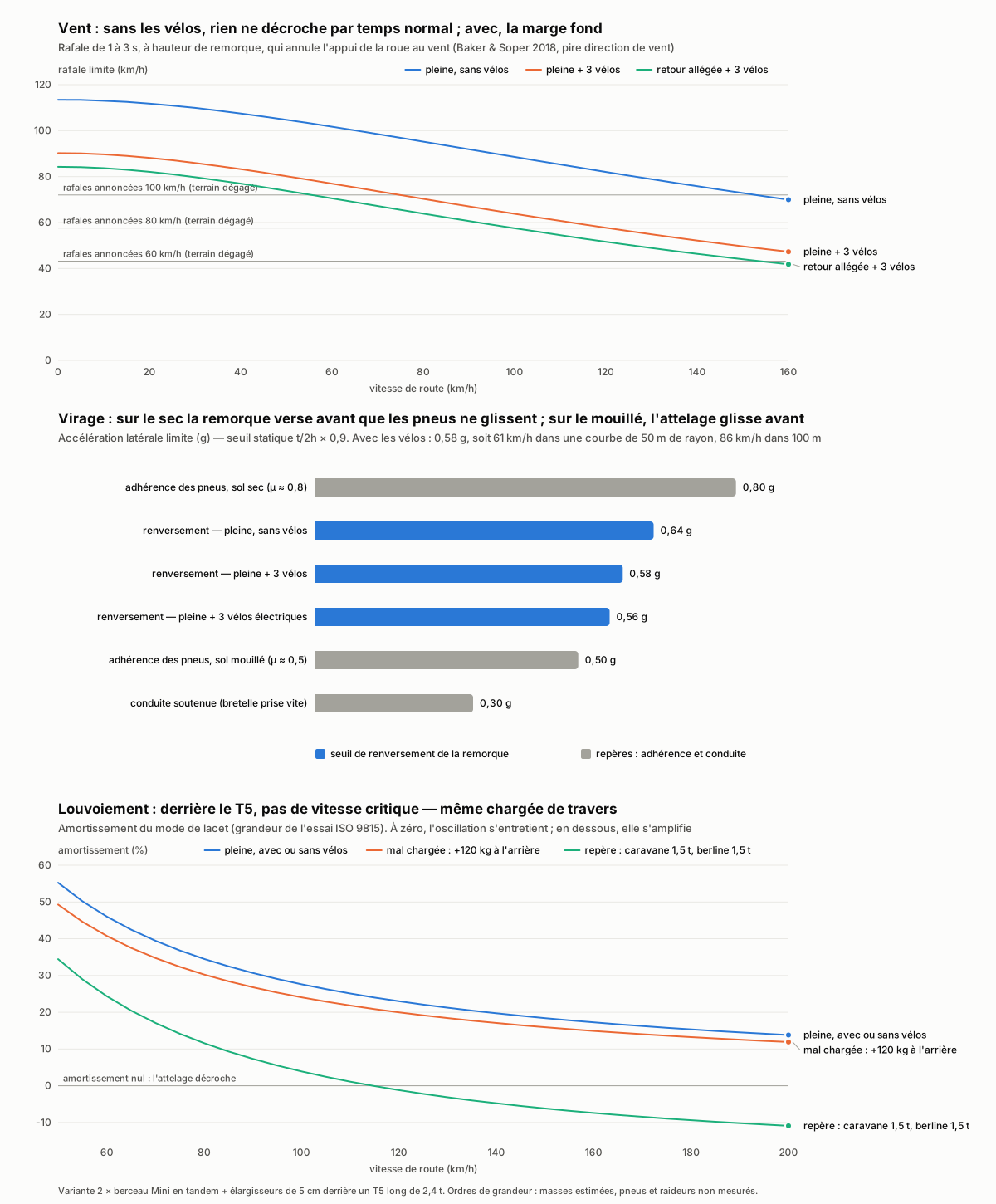
What I really wanted to know wasn’t what the highway code says: it was where the real limits are. The calculation yields three, gathered on one chart.
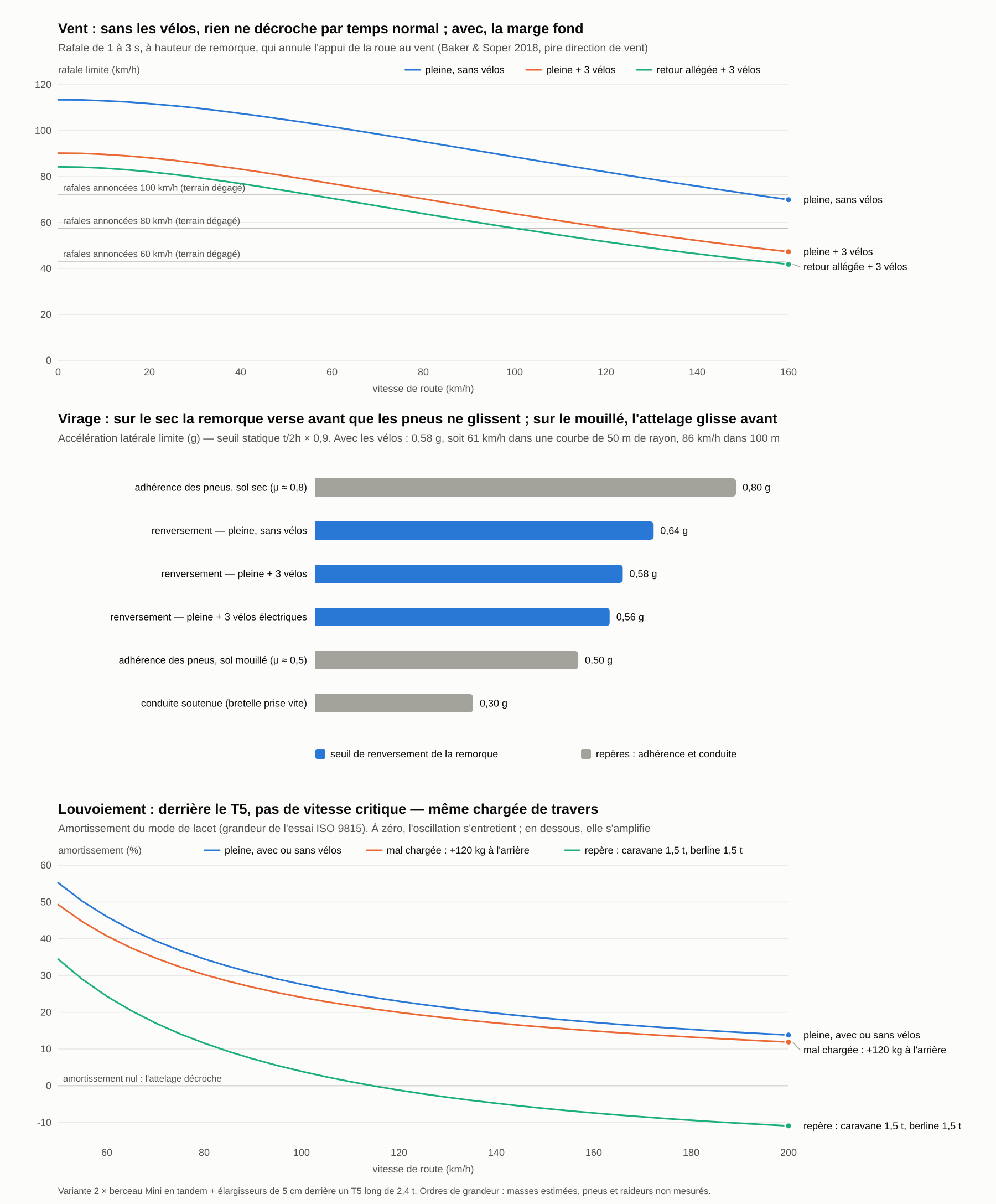
The three ways of letting go, for the twin Mini subframe variant (chart labels in French: vent = wind, virage = cornering, louvoiement = snaking). The Cordoba gives the same curves within a few km/h. Click to enlarge.
- Wind. Full and without bikes, nothing lets go in normal weather: it would take 110 km/h forecast gusts to worry it at 130 km/h. With the bikes, the margin melts.
- Cornering. The trailer tips over at between 0.56 and 0.64 g of lateral acceleration, depending on the load. That is before the tyres slide on a dry road (0.8 g), but after on a wet one (0.5 g). In other words: in the dry, it goes over without having slid; in the wet, the outfit slides first. With the bikes, 0.58 g means 61 km/h on a slip road of 50 m radius.
- Snaking. No critical speed behind the T5, even with 120 kg badly placed right at the back. The green curve is the control case, a 1.5 t caravan behind a saloon of the same weight: it drops below zero at around 115 km/h.
The Cordoba, down to one dimension
That left the problem opened by the correction: the spring-and-damper unit rising towards the body. Looking at what sits at that spot in the trailer, the constraint first tightened: the stove drawer on one side and the fridge slide on the other sweep the floor right above it. Nothing may protrude, not even a bulge.
Then the calculation loosened it. Under the trailer’s load (290 kg per wheel), the original spring compresses and the unit is only about 41 cm long. Its head can then sit within the depth of the frame, 45 mm below the floor, on a plain drilled plate welded between two rails.
On one condition, and it is the only unknown left: that the unit’s lower eye sits less than 1.5 cm above the wheel centre. I assumed 3 cm below; it takes five minutes to measure on the car, before dismantling it. If the dimension turns out wrong, there are height-adjustable coilovers approved for this car.
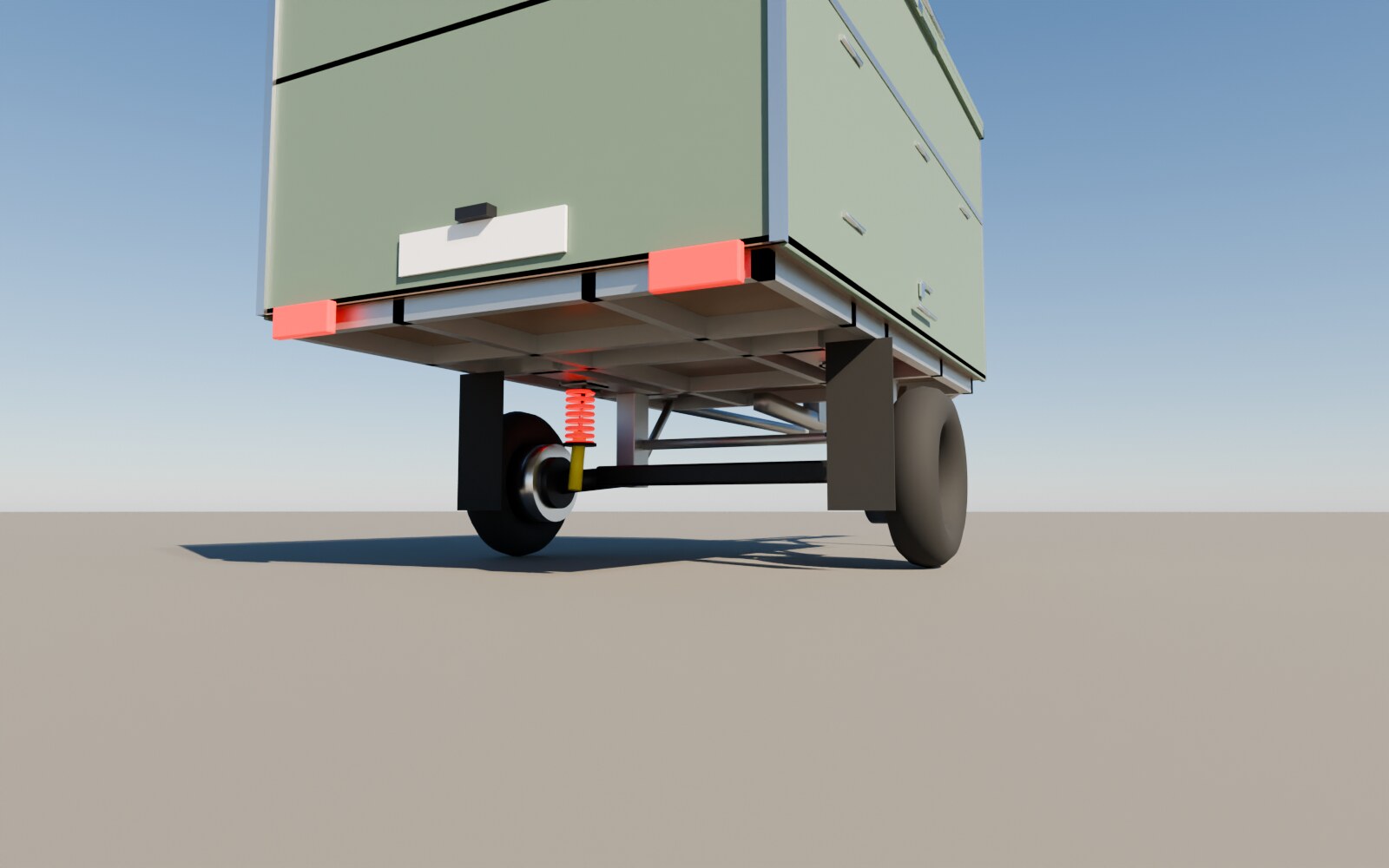
The Cordoba mounting as the calculation now draws it: the coilover stops inside the frame, and two brackets drop down to reach the arm pivots.
The real fabrication work is elsewhere, and I hadn’t seen it. Because the body sits above the wheels, the frame is 67 cm off the ground while the axle’s arm pivots are at 33 cm. So it takes two 35 cm drop brackets, which see about 1.6 kN·m on a pothole taken fast: box sections in 5 mm plate, a brace running forward, and a tube between the two to carry side loads.
This mounting is still far simpler than the tandem: one axle, four fixing points, nothing to adjust, tyres you find everywhere, and a trailer you can still move by hand. The tandem has more margin and a lower floor. I haven’t decided.
Second update, 21 September: everything comes down
The same day, a few hours later. Two design questions did more for the trailer than all the morning’s calculation refinements.
Sinking the axle into the body
From the start, the body sat above the wheels. That is what let it be wider than the track, and also what perched the floor at 75 cm. Hence my question: why not do as the Seat itself does, or any van? Drop the floor between the wheels, let them rise into wheel arches inside the body, and build the drawers around them.
The floor can come down until it nearly brushes the beam joining the two wheels: 0.51 m instead of 0.75. Everything else follows as one block, 24 cm lower. And the two difficulties of the mounting, the ones from this morning’s update, vanish at a stroke:
- the 35 cm brackets that had to drop from the frame down to the arm pivots shrink to 10: the pivots bolt almost directly under the rails, as on the car;
- the head of the coilover no longer has to fit under a floor. It rises into the wheel arch, exactly as it does in the Seat’s boot. The famous dimension to measure no longer decides anything: it merely sets the height of the wheel arch.
The price is joinery and frame work. Two wheel arches of 73 × 36 cm, 20 cm high, take about a hundred litres out of 2,400. Each side flap gets a notch at the wheel. And the frame is no longer a rectangle: the wheel is in the way of the outer rails, so two rails run inboard of the wheels, and cross-members carry the sides ahead of and behind them.
The layout reorganises itself around a simple rule: whatever needs little height goes above the wheel, whatever needs a lot goes in front or behind. The stove drawer is 22 cm high. It was already level with the axle; it stays there, sitting on the wheel arch. The sink gains a deep drawer, with room for a grey-water can beneath. The fridge leaves the axle line for the rear — and since everything has dropped, its lid goes from 1.27 m to 1.03 m: you can finally reach into it.
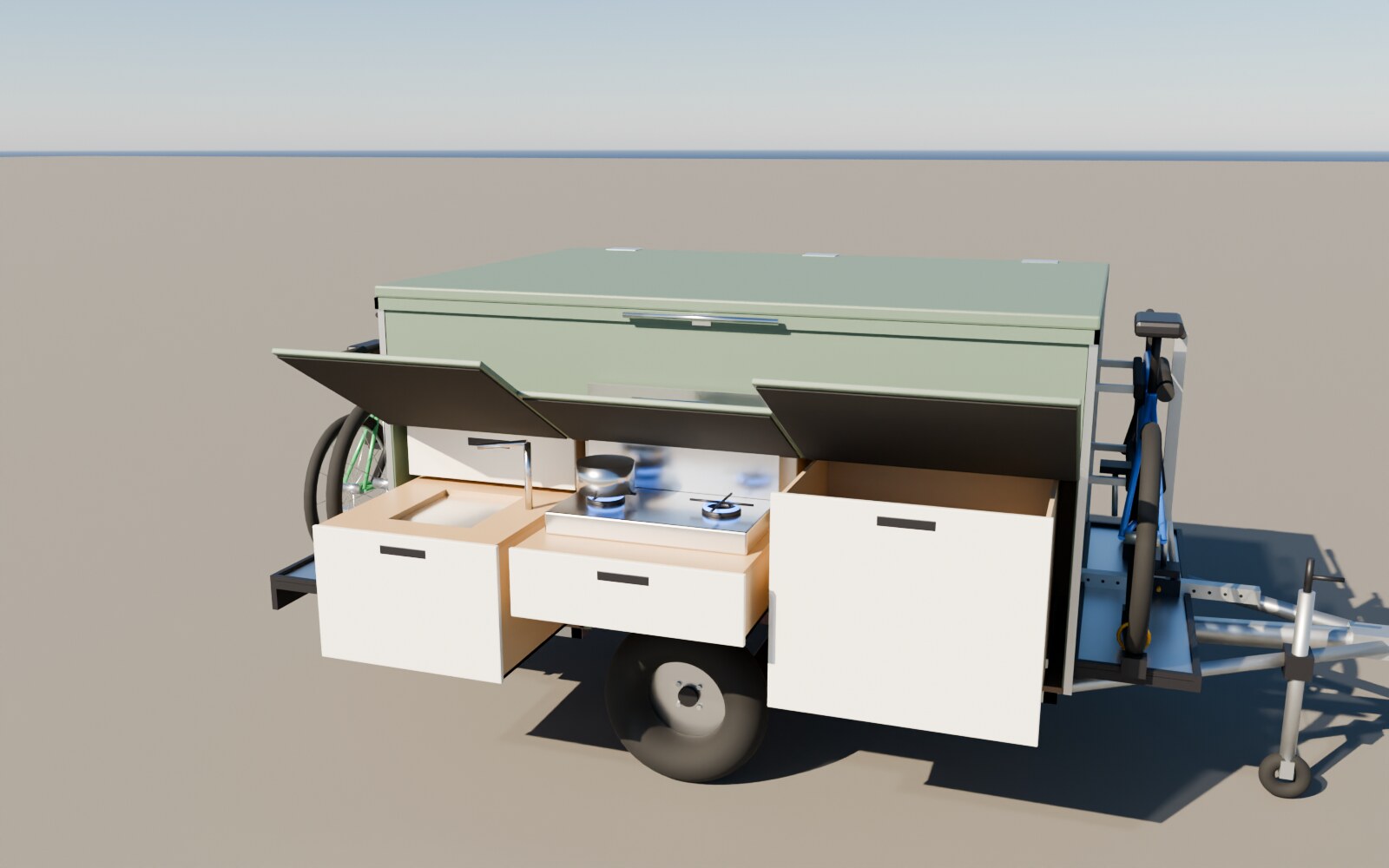
Kitchen side. The stove drawer sits on the wheel arch; the sink and the water column, either side, go down to the new floor.
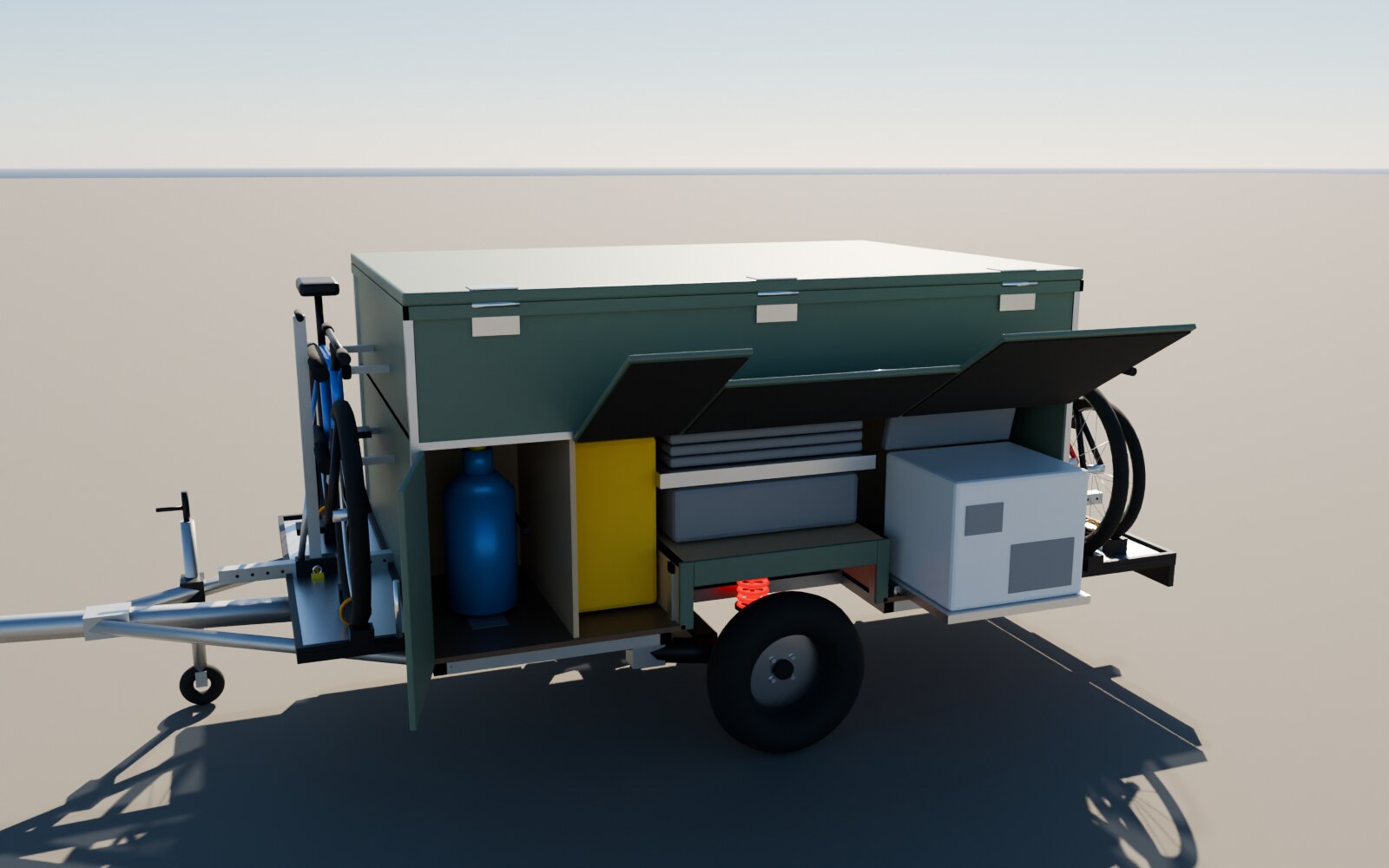
Fridge side. The fridge has moved to the rear; above the wheel, whatever stows flat.
On the road: the centre of gravity drops by 21 cm, cornering rollover goes from 0.58 to 0.71 g, and the limiting gust at 110 km/h from 55 to 66 km/h.
The idea doesn’t combine with the morning’s. With two Mini axles, the wheel arches would be 1.45 m long, 63% of each side: there would be almost no low drawers left.
The bikes come down from the roof
Second question: why insist on lifting three bikes to nearly 2 m? They could sit on a carrier behind the trailer. Or two behind and one in front, on the drawbar.
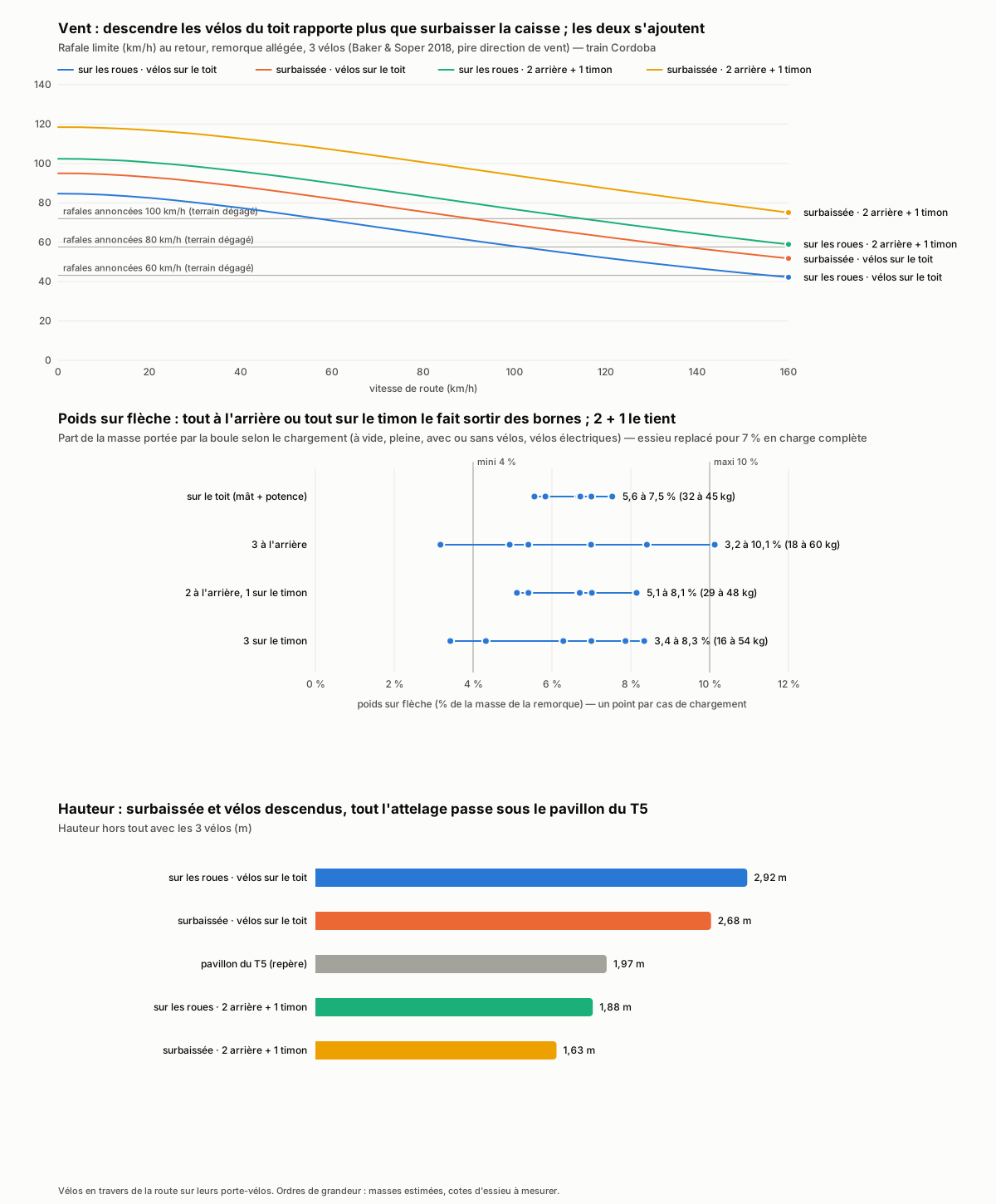
For wind, it’s no contest. Set crosswise a metre off the ground, the bikes are hit end-on by a crosswind, and they are no longer perched: they hardly count in overturning any more. But it is the nose weight that separates the locations, and there the calculation didn’t say what I expected.
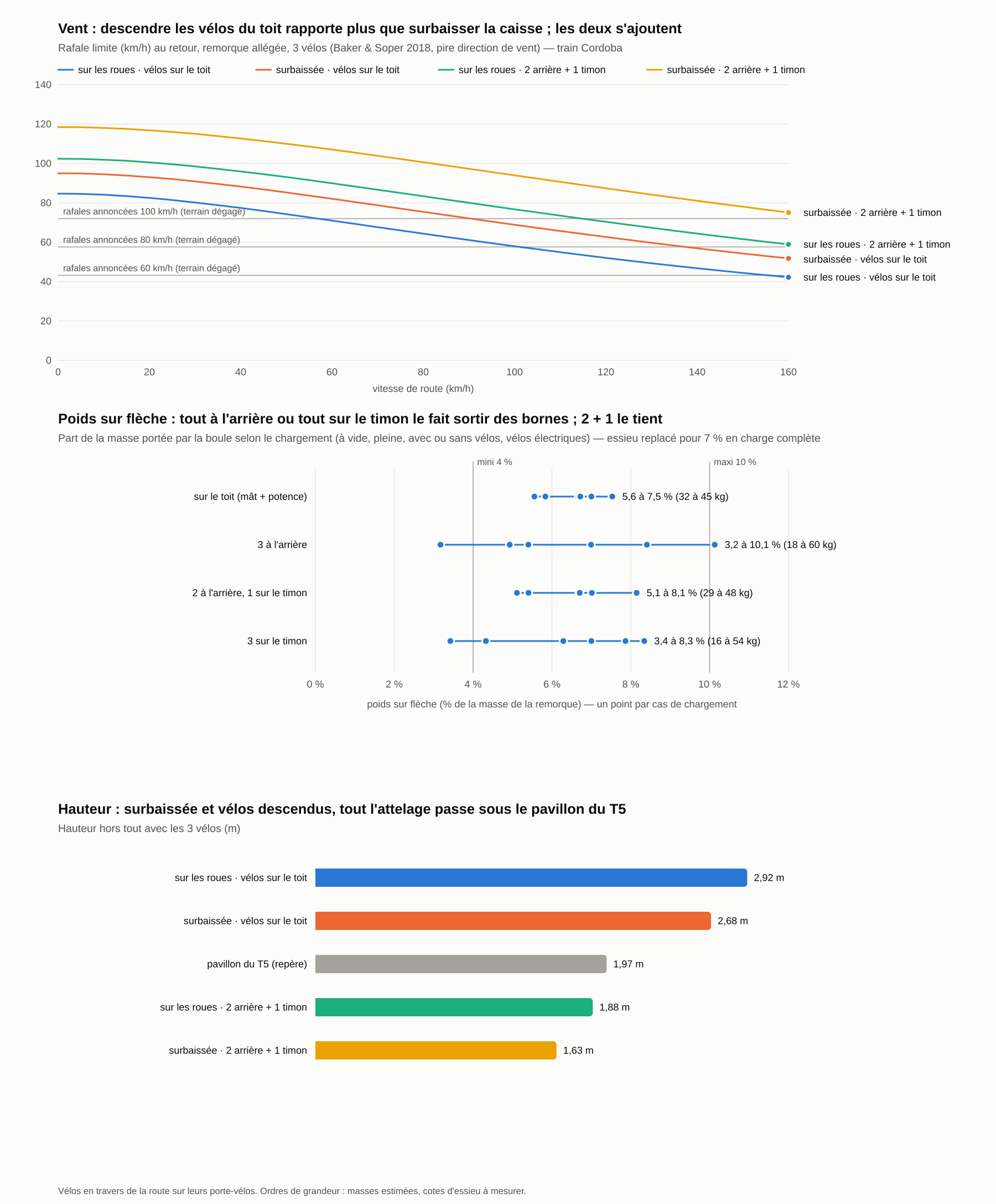
In the middle, nose weight for each location: one dot per loading case, between the 4% and 10% bounds (chart labels in French). Click to enlarge.
- Three bikes at the rear: 40 to 60 kg a metre and a half behind the axle. Depending on whether the trailer is full or empty, with or without bikes, nose weight ranges from 3 to 10% of the mass. Too little on the way home with e-bikes, too much when driving without bikes. It is exactly what caravanners hold against rear bike racks.
- Three bikes on the drawbar: the opposite flaw. The ball unloads as soon as you drive without bikes.
- Two behind, one in front: the front bike balances the rear ones. Nose weight stays between 5 and 8% in every case, as well-behaved as with the bikes on the roof. The heaviest goes in front.
Snaking doesn’t move. Three bikes right at the back raise the trailer’s rotational inertia by 17%, and behind a T5 four times heavier that changes nothing. Behind a saloon it would be another story.
The carrier I’ll build myself, and it is restfully simple: a platform, and a clamp sliding on a rail along the trailer’s centreline. Set the bikes crosswise, push the clamp in until the frames are pressed against bumpers fixed to the body, pin it, padlock it — the clamp doubles as an anti-theft device — then strap the wheels. The model brought out two details. The handlebars have to be turned a quarter turn. And even with the cranks vertical, the pedal sticks out 14 cm: so the bumpers stand 15 cm off the body, otherwise the pedal touches before the frame does.
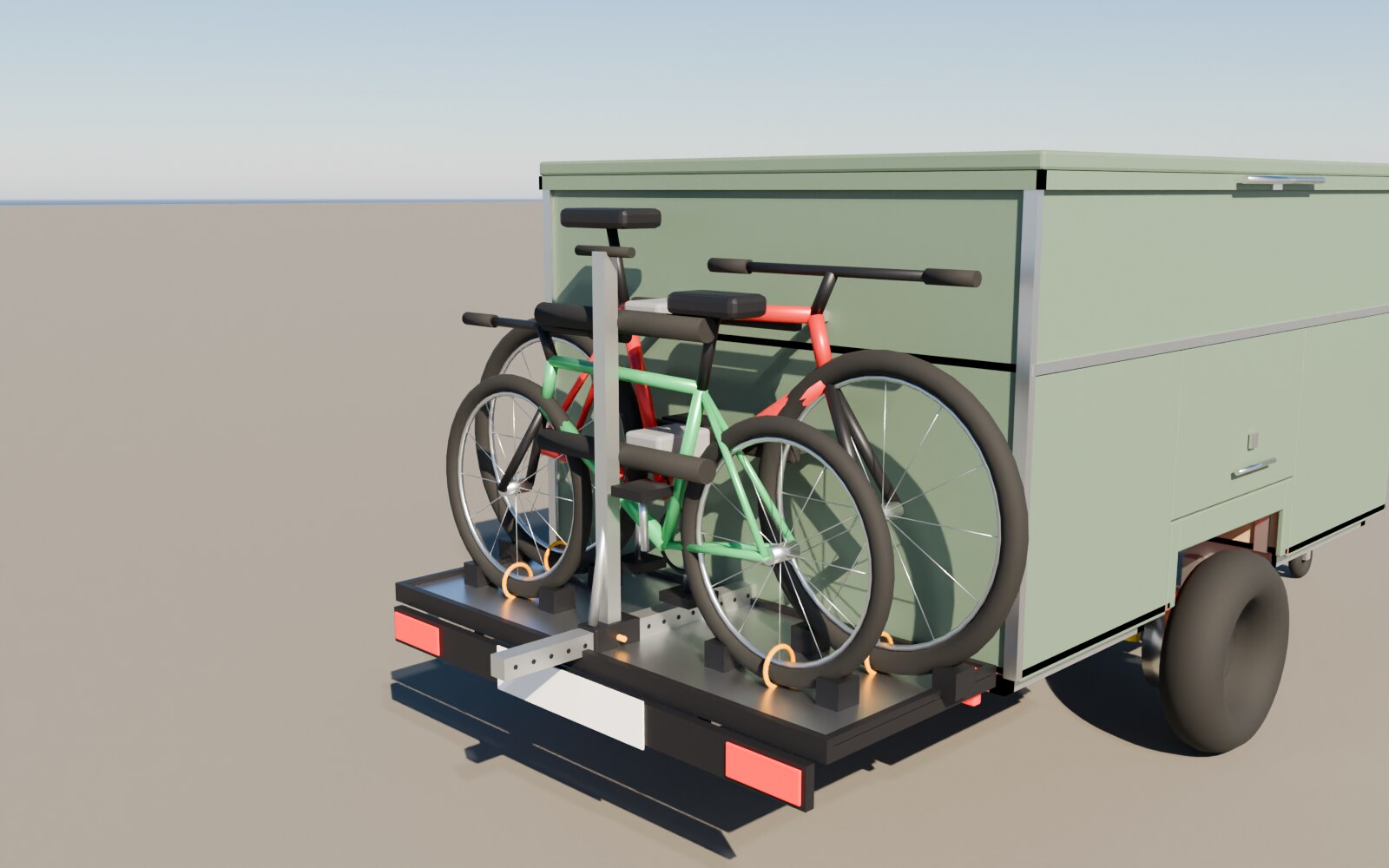
The rear carrier. The clamp slides on the drilled rail, on the centreline; orange pin and padlock on the slider; orange straps on the wheels; lights and plate repeated behind the bikes.
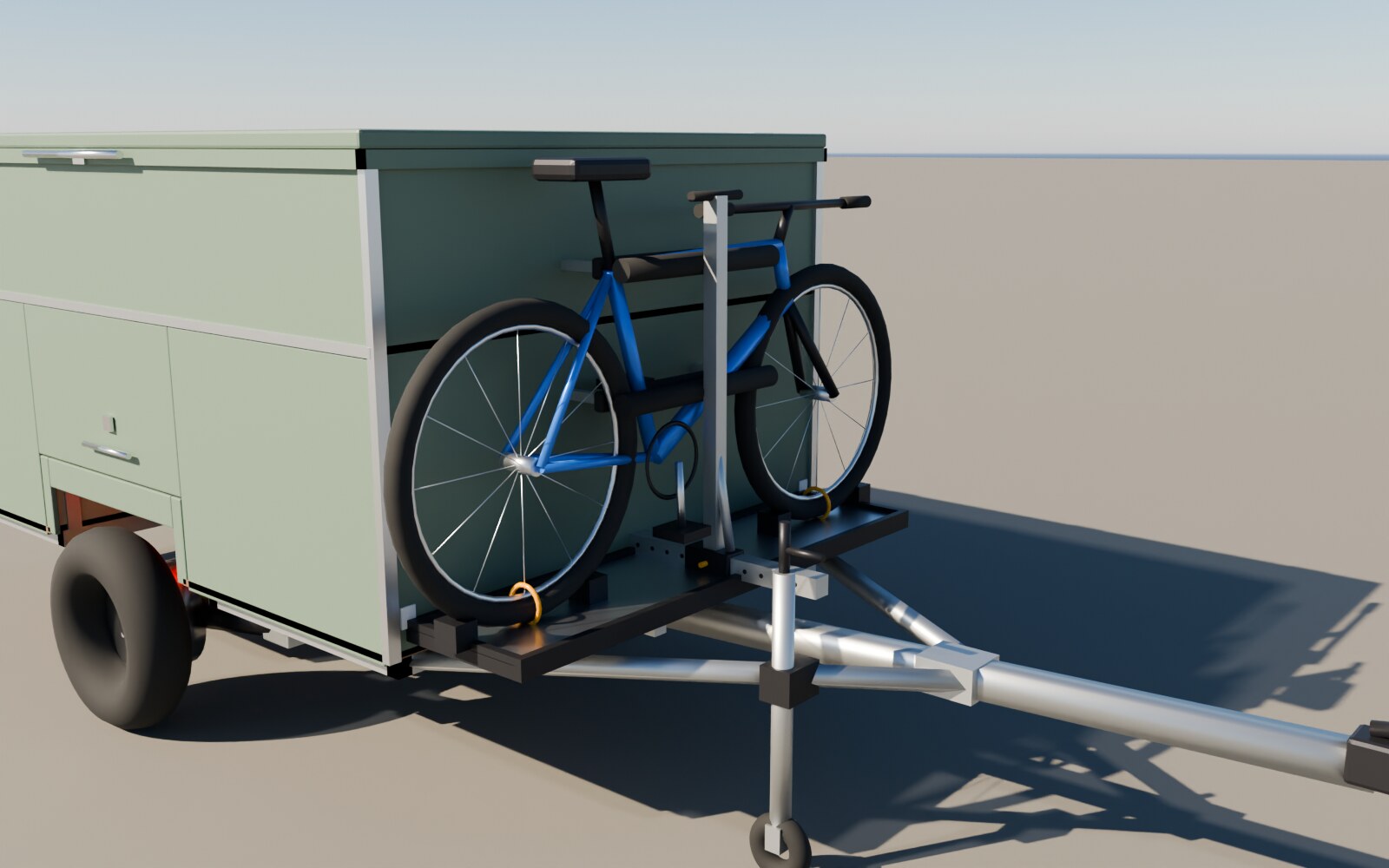
The same principle on the drawbar, for the heaviest bike. On full lock it stays well clear of the T5.
What this changes in use matters more than the numbers. The mast, jib and winch of the section Lifting three bikes to almost 2 m no longer exist: a bike is loaded at waist height. And the model’s first lesson — the bikes sit on the lid, as long as they’re there the box doesn’t open — falls too.
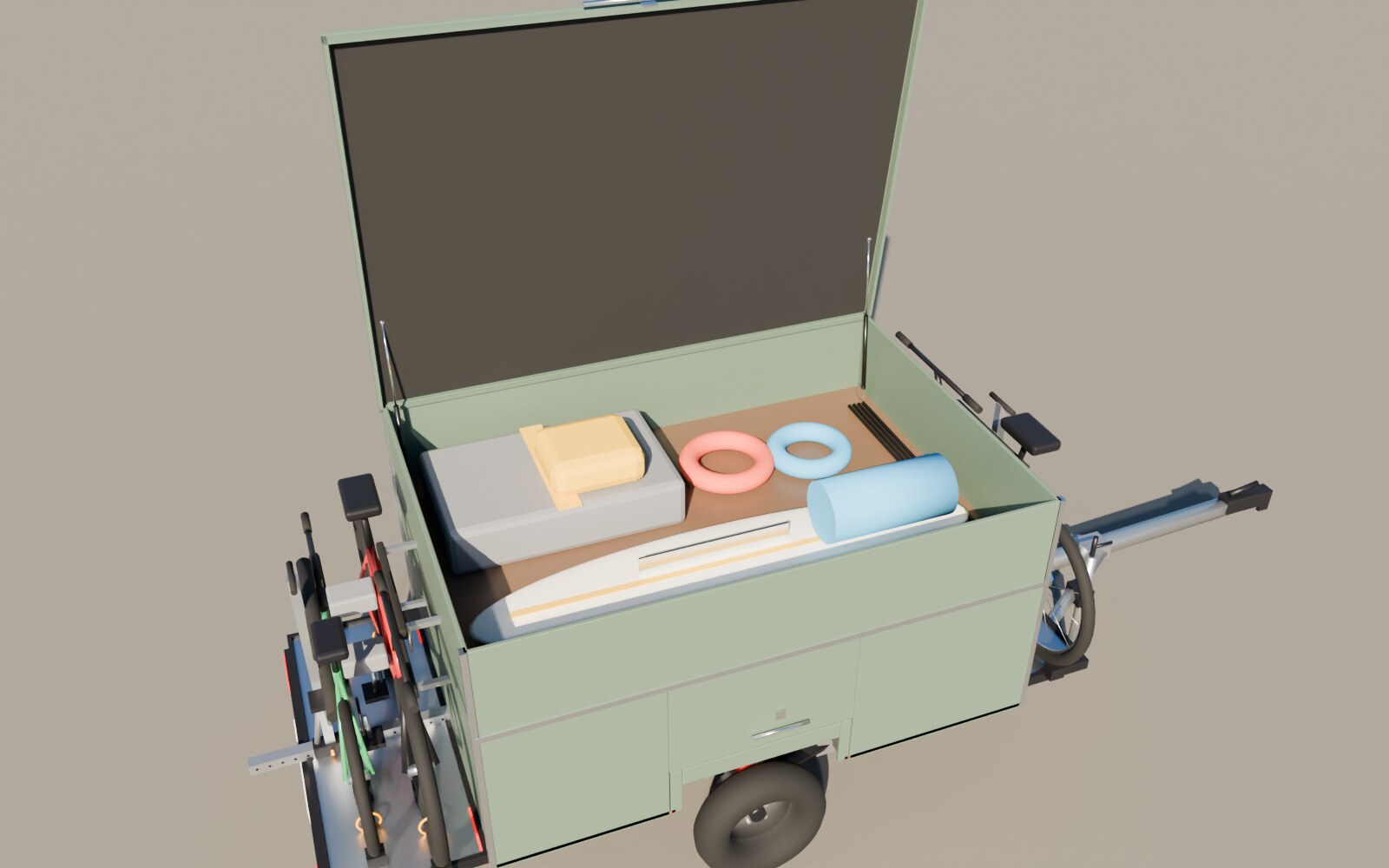
The box opens with the bikes loaded.
The chosen version
This time I’ve decided: Cordoba axle, lowered body, two bikes behind and one on the drawbar.
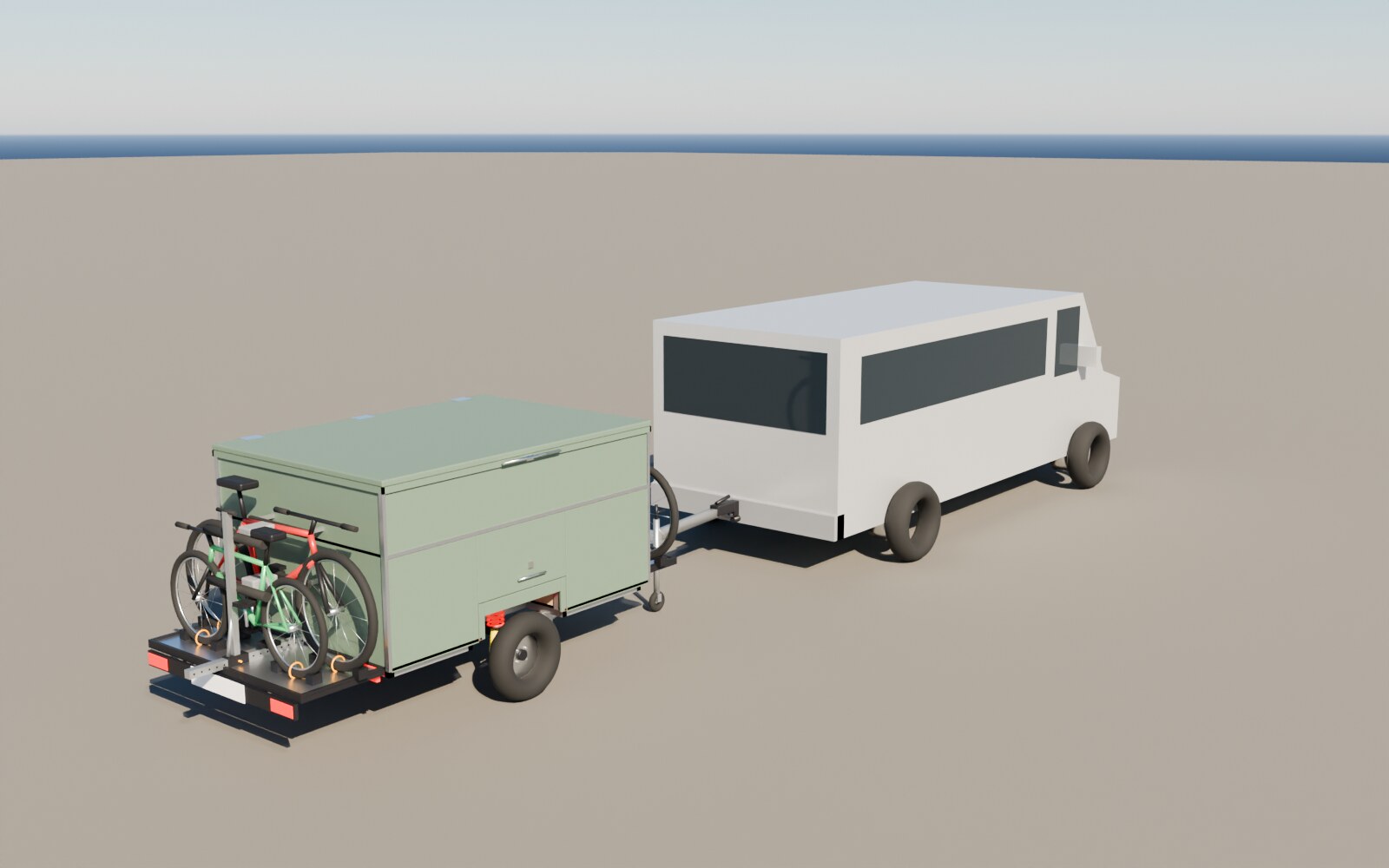
Hitched. The whole outfit passes under the T5’s roofline.
| 19 September project | Chosen version | |
|---|---|---|
| Floor | 0.75 m | 0.51 m |
| Overall height, bikes loaded | 2.92 m | 1.63 m |
| Overall length | 4.35 m | 5.09 m |
| Cornering rollover | 0.58 g | 0.79 g |
| Gust withstood at 110 km/h, on the way home | 55 km/h | 91 km/h |
| Nose weight, all loadings | 5.5 to 7.6% | 5.1 to 8.2% |
| To load a bike | a 3.45 m mast, a jib, a winch | put it down |
At 0.79 g, the rollover threshold meets the grip limit of the tyres on a dry road: the trailer would slide before tipping. And at 1.63 m, the whole outfit passes under the T5’s roof, hence under the same car-park barriers it does.
The price: 74 cm more length, lights and a plate to repeat behind the bikes, bikes exposed to road spray, and a frame more complicated to weld than a rectangle.
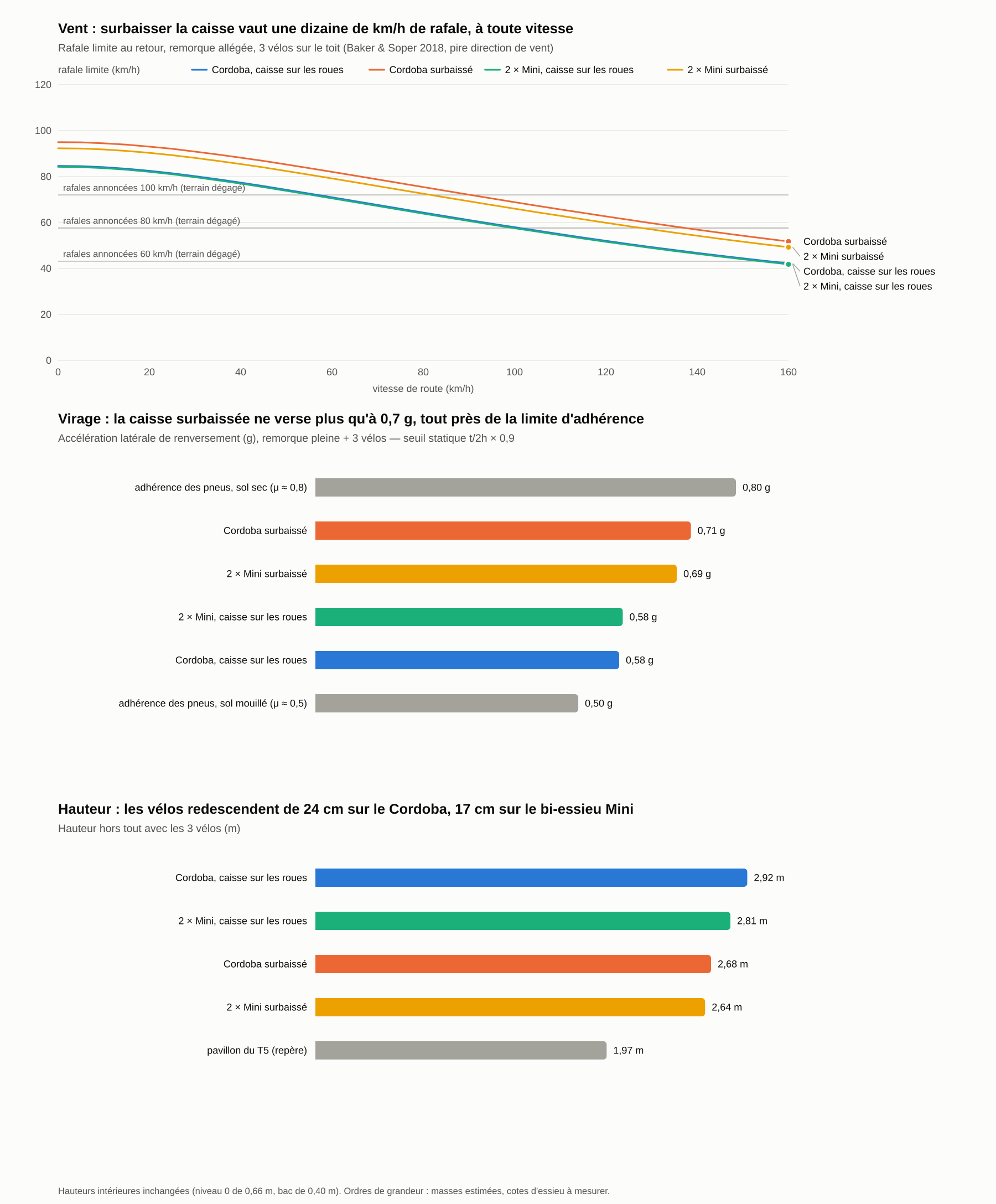
Body over the wheels versus lowered body, for the Cordoba and for the two Mini axles (chart labels in French). Click to enlarge.
What I take away
A render is not a check. The first pictures were convincing and rested on an axle 20% overloaded. What moved the project forward wasn’t the 3D model, it was the question “how much does it weigh, and where”.
Distrust a result that’s too comfortable. “Stable above 400 km/h” could have been a bug. The only way to know was to run the same calculation on a case with a known answer. Same reflex as with dimensions that add up: consistency isn’t proof.
Check against the real part. The spring mistake came neither from a calculation nor from a render, but from a generalisation (“on this kind of axle, the spring sits on the arm”) never checked against the actual car. Remembering the car was enough to spot it, and a workshop guide confirmed it.
An absurd error is good news. 164° of articulation, you spot it immediately. The dangerous errors are the ones that give a plausible number — like those 55° that didn’t depend on drawbar length, which only that detail gave away.
Parametrise everything. Switching axles took one line: the body widened, the floor rose, the kitchen drawers got shorter to keep the worktop at 0.95 m, and the calculation moved the axle. On paper, that would have been a week of erasing.
Look for the published method before writing your own. (Added 21 September.) The wind calculation was corrected three times before I asked what the literature said. The answer fitted in three lines and rested on measurements; the home-made model, on stacked assumptions. An AI writes a plausible physical model in thirty seconds, and that is precisely the danger: nothing pushes it to go and check whether one already exists.
A field objection is worth a code review. I can’t compute a lateral lift force. But “I’ve seen tall trailers that don’t suffer from wind”, “a bike isn’t a panel”, “there’s a van in front”: each of those remarks found a real flaw. Make them, and insist they be checked by calculation rather than answered with an argument.
The lever was the architecture, not the calculation. (Added on the evening of 21 September.) A morning spent refining the wind model moved the result by a few km/h. Two design questions — why is the body so high, why are the bikes on the roof — took it from 55 to 91. The AI was diligently optimising the project I had given it; it never questioned it. That was my job, and it took me two days.
What’s left to do
- Measure two dimensions on the Cordoba, car standing on its wheels: the height of the axle beam (it sets the 43 cm under the frame, hence everything else) and that of the coilover’s lower eye (it sets the height of the wheel arch). While there, record the position of the arm pivots and the drilling pattern of their brackets.
- Design the frame for real: two rails inboard of the wheels, cross-members carrying the sides, a tube bridge over each wheel, and sealing of the wheel arches.
- Try the drawbar bike for real: it has to coexist with the jockey wheel and the gas locker door.
- Read the maximum rear axle load off the Cordoba’s manufacturer plate, and check the bushes and bearings.
- Weigh it. The masses in the calculation are estimates. The finished trailer will go on a scale, nose and axle separately, and the axle can still slide a few centimetres along its rails before the final weld.
- Paperwork (French rules). Loaded, the trailer will exceed 500 kg gross weight: it will need its own registration, hence an individual type approval (RTI) from the DREAL for a home-built trailer. Staying under 750 kg means no mandatory brakes and a standard B licence. To be confirmed, along with the towing capacity and gross train weight on the T5’s registration.
- Build light. Every kilo saved on the body is a kilo of margin on the axle and a bit more stability in a crosswind.
Frequently asked questions
Can you use a Mini axle for a trailer?
Yes, for a small light trailer: it’s compact, low, and the 10-inch wheels allow a low floor. But it’s the rear axle of a 650 kg car, designed for something like 450 kg at most. A fitted-out trailer (kitchen, fridge, water, bikes) easily puts more than 500 kg on its axle.
How much nose weight should a trailer have?
Between 5 and 10% of the trailer’s mass, never less than 4% and never more than the car’s tow bar accepts (often 75 to 100 kg). Here, 7% fully loaded, about 44 kg. You get it by placing the axle, not by adding ballast.
Does a coil-spring axle take up more room?
It depends how it’s mounted. A separate spring sitting on the arm fits under the frame when the body sits above the wheels. A combined spring-and-damper unit, as on the Seat Cordoba 6K or VW Polo 6N, rises above the wheel: you have to make room for it in the body, raise the floor, or replace it with a separate spring and damper. Check before concluding, though: under load the spring compresses, and on my trailer the original unit ends up fitting within the depth of the frame, give or take one dimension.
How long should a drawbar be for easy reversing?
What matters is the ratio between the trailer’s ball-to-axle distance and the car’s rear-axle-to-ball distance. Above 2.5, reversing becomes comfortable; here, 2.8 with a 2 m drawbar. Shape matters as much as length: a single central beam near the ball keeps the drawbar’s V from touching the car in tight turns.
Can a light trailer snake behind a van?
Very unlikely if the van is much heavier: the calculation finds no instability below 400 km/h with a 2.4 t T5 and a 0.6 t trailer. The practical risk is crosswind, and above all whatever you perch on the roof.
At what wind speed can a trailer blow over?
It depends on its mass, its track, its height and the speed you drive at. The reference method is Baker and Soper (2018), used for traffic restrictions on bridges. For my 0.6 t trailer: an 85 km/h crosswind gust at 110 km/h with nothing on the roof, 55 km/h with three bikes. Those are wind speeds at trailer height; forecast gusts, measured 10 m up, are about 40% stronger.
Are two axles better than one on a small trailer?
They carry more and hold their line better: the tyres resist yaw nearly five times as much. In exchange, the trailer scrubs its tyres when manoeuvring and can no longer be moved by hand, it weighs more unladen, and if the two axles are independent (rubber suspension), the tow-ball height sets how the load is shared: it has to be towed dead level.
A short glossary
Bogie, tandem — Two closely spaced axles fitted one behind the other under the same trailer.
Coilover (spring-and-damper unit) — A damper with the spring fitted around it; the two go on and come off as one piece. Its head bolts into the car’s body.
Nose weight — The vertical load the trailer puts on the tow ball. Too low or negative, it lightens the back of the car and encourages snaking.
Snaking — Side-to-side oscillation of the trailer which, above a critical speed, grows instead of dying out.
Tyre scrub — Forced sideways sliding of the tyres when a twin-axle trailer turns: its two axles cannot follow the same circle.
Twist beam — An axle where the two trailing arms are joined by a cross-member that twists when the wheels don’t move together; it acts as an anti-roll bar.
Yaw — Rotation of a vehicle about a vertical axis: the nose goes left, the tail goes right.
RTI — Réception à titre isolé: French individual type approval, by the regional authority (DREAL), of a vehicle built or modified as a one-off.
Drawbar — The front part of the trailer, from the chassis to the coupling head.
Track — The distance between the centres of the two wheels on one axle.
References and local copies
- The complete, regenerable model: Blender and Python scripts,
remorque.blend, detailed calculation (comments and file names in French) —remorque-famille.zip - The calculation on its own, readable online (in French):
CALCULS.md - The charts, as vector files (labels in French):
limites.svg,architecture.svg,velos.svg - Baker & Soper (2018), The calculation of the overturning wind speed of large road vehicles at exposed sites (open access) — the wind calculation method, and the measurement of a trailer behind its lorry
- Mechanical Elements: rubber torsion axles fitted in pairs — why they don’t share the load
- Autodoc guide: replacing the rear suspension strut on a VW Polo 6N1 — the source for the spring correction
- The previous post — another part designed in dialogue with an AI, and the trap of dimensions that add up