The Fire, the Model, and What a Different Policy Would Have Changed
Part 2—six days of megafire, a model that learns to fight, and a political counterfactual run honestly
The first post told the story of building the tool and ended on its most uncomfortable lesson: the model does not predict what the fire will do, it predicts what it would do if nobody stood in its way. The gap between the two—a factor of 1.7 on the day the fire ran free, a factor of 12 on the day the crews held the front—is the firefighting effort itself, and the model did not represent it at all.
This post tells four stories: what the fire has done since, what the model learned by trying to represent the crews, what the real fight owes to an army nobody budgets for—residents and farmers—and what this model allows one to say—carefully—about a political question I was asked: if the program of L’Avenir en commun (“A Shared Future,” the platform of La France insoumise) had been in force for two presidential terms, what would it have changed on an episode like this one?
How you grade a model on the past—three terms that will come up all the way through. The hindcast (retrospective replay): you place yourself at a past instant, give the model only what was known at that moment, simulate forward, and compare against what actually happened. The area bias: the ratio of predicted burned area to observed burned area—a bias of 7.5 means the model burns seven and a half times too much. The AUC: draw at random one cell that burned and one that did not; the AUC is the probability that the model gave the higher score to the first. At 0.95, it is rarely wrong about the where—even when it is badly wrong about the how much.
Six days, forty-five thousand hectares
The facts first, because they set the scale. The main fire did not start at Biscarrosse: it started on July 22 at Saumos, in Gironde, from a brush-clearing worksite—1,400 hectares (ha) by that same evening. The Biscarrosse fire, a van in flames, followed the next day. From there, the days are counted in tens of thousands of hectares:
- July 24—19,000 ha in Gironde, 110,000 people evacuated, including the Cap Ferret peninsula by land and by sea;
- July 25—more than 32,000 ha, 167,000 evacuees, first drop of fire retardant—a product that does not evaporate like water but coats the vegetation to make it nonflammable—by a French Air Force A400M;
- July 26—42,000 ha, five towns at the gates of Bordeaux evacuated via FR-Alert (France’s cell-broadcast emergency alert system): roughly 220,000 people displaced in total, one of the largest peacetime evacuations in French history;
- July 27–28—a lull, firebreaks widened by bulldozer, the fire “contained but not fixed,” then “stabilized”… and a new heat wave announced by Météo-France (the national weather service).
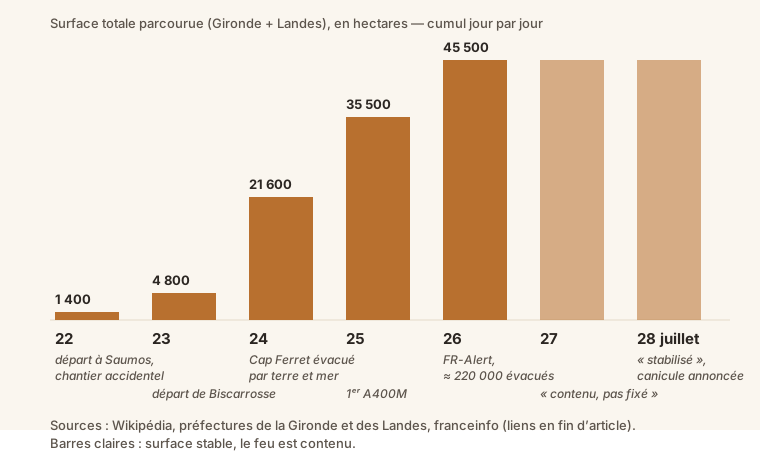
Click on the figures to open them full size.
At the last tally I could source: 42,000 ha in Gironde, 3,500 in the Landes, 88 firefighters injured, more than 2,750 firefighters and nearly 3,000 gendarmes and soldiers deployed, European reinforcements (Croatian Canadairs, Portuguese Air Tractors, Czech and Slovak heavy helicopters), a Reaper drone for thermal mapping. EDF stated that the Blayais nuclear plant, some fifty kilometers from the flames, is not under threat—so the question that launched this whole project has, for now, a reassuring answer. The CEA’s Laser Mégajoule facility, for its part, saw firebreaks dug in a hurry around its site.
📡 On the tool side: the map at kokusho.ss2i.ca is still tracking both fires. This morning, the model moved the Cazaux air base to heightened watch against the secondary fire—the observed front is 7.3 km away and a third of the no-suppression scenarios reach the 6 km zone within 48 hours. In fairness: no press source documents any threat to Cazaux; this is a model output, and a counterfactual one. That is exactly the distinction this post is going to spend its time drawing.
What worked in the model
Since the first post, the model has passed two tests and gone up a level.
First test: the fuel-exhaustion hypothesis. The over-prediction of July 25 (a factor of 12) had a rival explanation to the firefighting effort: maybe the fire was simply boxed in between the ocean, the lakes and its own scar, with nothing left to burn. The test is simple and I recommend it to every modeler: look at where the model burns its excess hectares. The verdict is unambiguous—94% of the predicted area falls on intact pine forest that the real fire never touched. The fuel was there. The fire did not take it. What stopped it was indeed the firefighting effort, and it had to be modeled.
Second test: two attempts at a suppression model, two instructive failures. The first drew lots, cell by cell, on whether the crews held: they would have needed to win 93% of the skirmishes; they were winning 15%. The second held entire stretches of track—some thirty kilometers held… which the fire calmly went around. The lesson deserves to be written in bold: you do not contain a wildfire by holding a lot of line, you contain it by holding a closed loop, anchored on barriers the fire will not cross. Containment is a problem of topology, not of local physics.
The level gained: modeling the incident commander’s reasoning. Finding the best closed loop around a fire, leaning as much as possible on water, already-burned ground and existing roads, is a problem mathematics knows how to solve exactly, and the idea can be told without an equation. Every path leading from the fire to the outside must cross the line of defense—otherwise the loop is not closed, and the fire will find the hole. Looking for the best loop therefore means looking for the cheapest-to-hold set of cells that cuts every path: this is what is called a minimum cut. A classic theorem—Ford and Fulkerson, 1956—says this cut can be computed by solving a flow problem: imagine trying to push a fluid from the fire toward the outside, with each cell letting through a flow rate equal to its defense cost; the maximum flow that manages to get through is exactly the price of the best barrier, and the cells that saturate are the barrier. This is what Dinitz’s algorithm computes, as implemented in SciPy. Water is free, a track costs half price, open pine forest costs full fare—and every kilometer is billed according to the probability that a crew can actually hold it, based on documented operational thresholds: below 2,000 kW per meter of front, direct attack is possible; above 10,000, nothing holds, aircraft included.
Byram’s fireline intensity (Byram, 1959): the power released per linear meter of front, in kW/m—the product of the vegetation’s heat of combustion, the mass consumed per square meter and the front’s rate of advance. It is the quantity that decides everything: a Landes pine forest running at 600 m/h releases about 6,000 kW/m—already beyond the reach of a direct ground attack. Flame height follows from it almost directly (about 4 m here).
Two implementation details, for anyone who wants to redo the calculation. First, flow algorithms put capacities on the links between cells, whereas here it is the cell itself one is buying: so each cell is split into an “in” node and an “out” node connected by an internal arc priced at the cell’s cost—the technique known as node splitting (Ahuja, Magnanti & Orlin, Network Flows, 1993, § 2.4). Second, the cut must separate cells counting their eight neighbors, diagonals included—the “Moore neighborhood” of cellular automata—because fire spreads diagonally too: a barrier that only blocks the four cardinal neighbors lets the fire slip between two cells set in a staggered pattern.
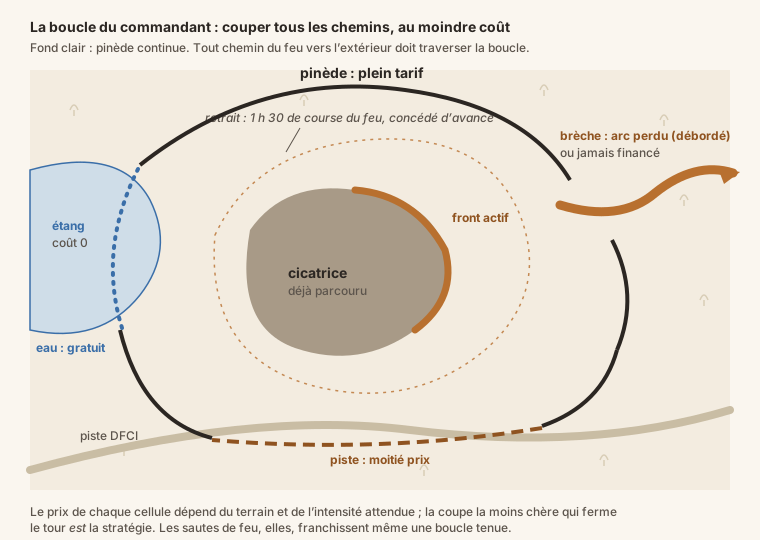
The commander’s loop, in principle: every kind of terrain has its price, and the cheapest cut that closes the circle is the strategy.
Tuning it was a lesson in humility by iteration, each one paid for with a hindcast of some twenty minutes:
- without a price on the area conceded, the “optimal” cut went looking for lakes thirty kilometers away and gave up 150,000 hectares—mathematically minimal, operationally absurd;
- a line held at 3 a.m. is not held at 3 p.m.: I had to add overrun, the re-testing of lines when the front intensifies sharply—the midday surge that breaks the lines established overnight;
- and resources are finite: the defense is always attempted, but units wear out arc by arc, and the funding gaps become the breaches through which the big fires spill over.
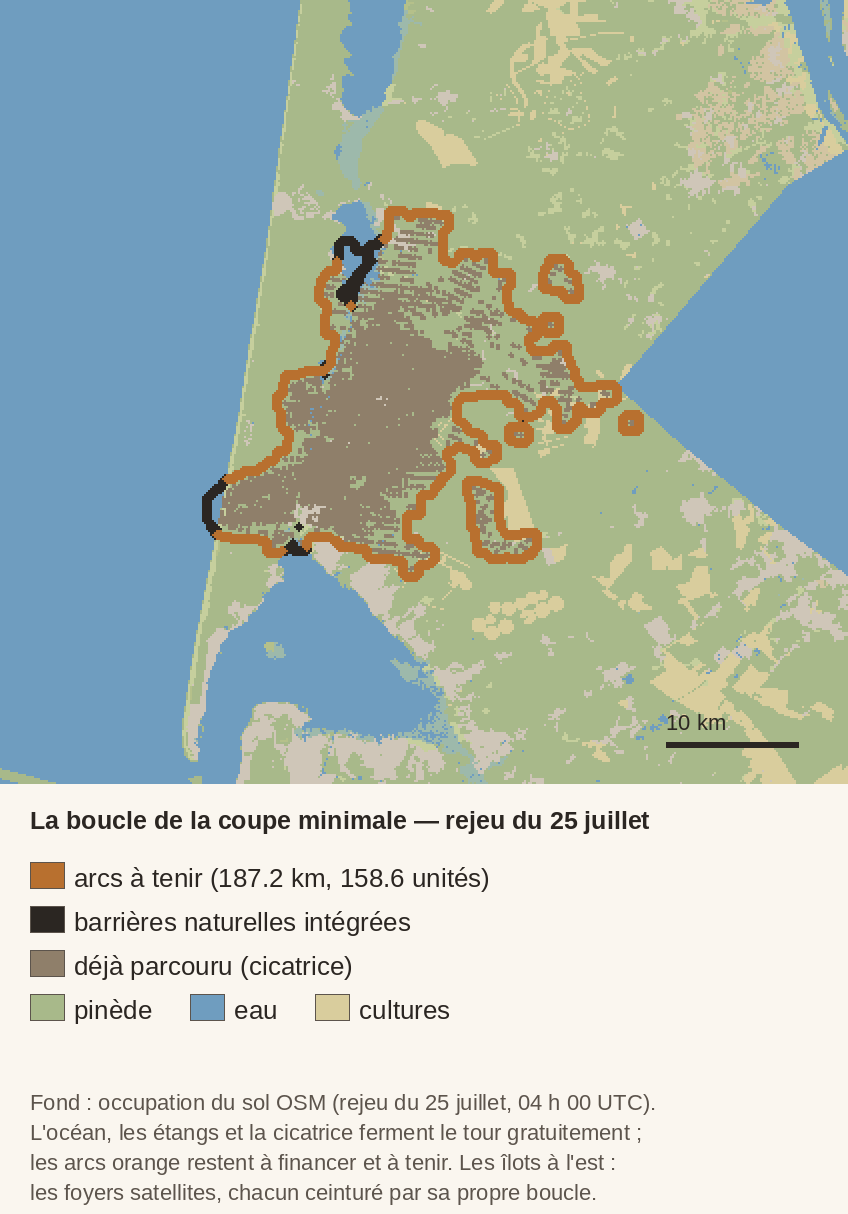
And the same loop for real: the plan computed by the minimum cut on the July 25 fire, anchored on the ocean, the lakes and the scar. Each orange islet to the east rings a secondary fire detected away from the main one.
The result, on the two reference days: on the contained day, the bias falls from 12 to 7.5—better, not good; the remainder is split between the nooks of the scar the satellite never saw burn, the spot fires the model does not yet fight, and fuel moisture, still computed by an instantaneous formula with no memory (Simard, 1968): it looks only at the hour’s temperature and humidity, so that an afternoon at 39.8 °C can appear wetter than the day before. The known remedy is the Canadian Forest Fire Weather Index (Van Wagner, 1987) and its cumulative components DMC and DC—two “reservoirs” that fill with every rain and drain day after day with the heat, thereby keeping the memory of weeks of accumulated drought. That is the next job. On the day the fire escaped, on the other hand, the model now predicts a mean area within 14% of the observed, and it knows why: the lines held in the morning give way at the thermal peak. In both cases the AUC stays above 0.95—the model still knows where the fire is going.
The experiment a model makes possible: varying the resources
And this is where modeling becomes a political instrument—in the noble sense. Version 3 parameterizes the firefighting effort in “units deployed,” one unit holding about one kilometer of line, with the headcount drawn at random around a mean calibrated on real mobilizations (2,000 to 2,750 firefighters on the great Gironde fires of 2022 and 2026). Nothing then stops you from turning the dial: what happens with 30% fewer resources? With 50% more?
I replayed the two reference days at three levels of deployment, twenty draws each:
| Resources committed | July 25 (holdable front) — median new area burned | July 24 (unholdable front) — median new area burned |
|---|---|---|
| −70 % (“three megafires at once”) | 22,067 ha | 8,244 ha |
| −30 % (“austerity continues”) | 18,352 ha | 6,154 ha |
| Nominal (actual mobilization) | 18,324 ha | 6,154 ha |
| +50 % (“the public service rebuilt”) | 18,324 ha | 6,154 ha |
Hindcasts at +12 h, 20 draws per deployment level. “Median”: half the draws burn more, the other half less—more robust than a mean against extreme draws. Observed: 1,645 ha on the 25th, 4,642 ha on the 24th. Orders of magnitude from an experimental model, not forecasts.
I was expecting a nice downward curve—more resources, fewer hectares. The model answered something else, and it is the most interesting result of the week: resources do not buy hectares, they buy a loop. Below the threshold where the loop stops being affordable—here, around −70%, the equivalent of a force spread across three simultaneous megafires, which is exactly the fear for the summers ahead—you lose thousands of hectares at once. Above the threshold, the marginal return collapses: between nominal and +50%, not one hectare of difference. And on July 24, the whole column says it: line up 34 units or 168, the fire gets through—the lines give way to intensity, not to numbers.
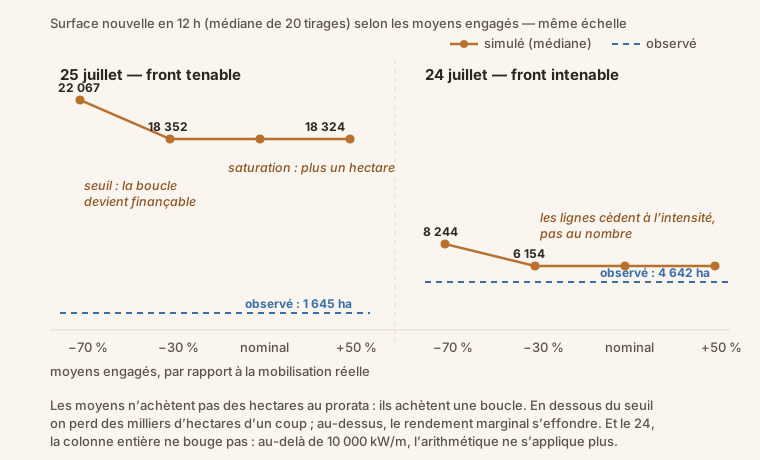
The shape of the curve is the result: a threshold, then saturation—and on July 24, a curve that resources no longer move.
An important caveat before drawing political conclusions from it: this table understates the real effect of resources, because the model represents neither initial attack—smothering an ignition within the first hour, where every available Canadair counts double—nor the speed of aerial rotations, nor the splitting of the force across several fires. What it establishes is the shape of the curve: a threshold, then saturation. Not the uselessness of resources.
The other army: the logistics that crack, and the people who carry them
There is one thing that neither the table nor the curve shows, and that leaps out as soon as you read the situation reports and the local press: the question was not only how many units, but how they stayed on their feet. Logistics—water, vehicles, aircraft, feeding the crews—was the weak link from end to end, and it was cracking before the episode even began.
The facts, with dates. During the fires, seven Canadairs out of twelve were operational, the rest grounded for maintenance on thirty-year-old airframes—and the order for two additional aircraft had been canceled in 2024, before being placed again in June 2026 for delivery… in 2032. The national fleet of wildland fire engines went from 5,117 in 2002 to 3,845 in 2020, with the share of aging vehicles rising from 51 to 61%; the firefighters’ federation estimates that 10,000 would be needed. Three weeks before the episode, on July 6, a union of professional firefighters warned that more than 300 vehicles were missing to cover the needs of a season already at 7,000 fire starts. On the ground, a battalion chief was asking for a 13,000-liter tanker to “keep a permanent water supply,” reinforcement columns were arriving from the Paris region, and a volunteer firefighter from Bouches-du-Rhône died on the road—on a resupply mission. A chief warrant officer put it bluntly in the press: “we don’t have enough resources, human or material, to respond to disasters of such a scale.” These are not accidents: the Cour des comptes (France’s supreme audit institution) spoke in 2022 of a “failure of anticipation” on the aerial fleet, the Senate (2022) of “chronic under-investment” in fire engines, and the firefighters’ federations of a “model running out of breath.” Four years later, the 2026 episode played out with those very failures—known, written down, and uncorrected.
And yet the lines held on the days that were holdable. Partly because a second army rose up, one that nobody budgets for. On July 24 at 7 a.m., the préfecture of the Landes (the local office of the national government, headed by the préfet) officially issued “an appeal for solidarity to farmers to bring water tankers”—those trailer tanks holding tens of thousands of liters that are towed behind a tractor, and that refill the fire engines as close as possible to the front. Within hours, the Gironde chamber of agriculture registered more than 500 volunteers—Médoc winegrowers, wine merchants with their tanker trucks, public-works contractors with stubble cultivators, blades and bulldozers—of whom about a hundred would actually work the Saumos fire, to the point that the appeal was suspended on the 27th, overwhelmed by the influx. The timber industry felled 22 kilometers of pines in twenty-four hours to open firebreaks—103 km of firebreaks and access tracks created in total, says the prefectoral report of the 27th. Behind the front: volunteers running the supply centers for the 2,750 firefighters, restaurateurs preparing thousands of meals, veterinarians treating evacuated animals for free, the Bordeaux-Lac exhibition center opened for 10,000 people. None of this was improvised from scratch: back in 2022, at Landiras, farmers’ slurry tankers had saved the firefighters “up to three hours a day” according to the chamber of agriculture—and it was precisely this experience that Gironde had begun to formalize, a month before the episode, by taking inventory of the farm equipment that could be mobilized.
Let us reread that through the model’s lens, because it sheds light on both. The model counts “units that hold a kilometer” without asking who crews them: in reality, some of those units were tractors. The water resupply, the three hours a day of 2022, the plowed firebreaks—in the model’s vocabulary, that is endurance: arcs that stay held instead of giving way for lack of water, units that stay on the line instead of shuttling back and forth. In other words, the margin below the threshold, the margin the curve shows decides everything, was partly supplied by society itself—at the very moment when the State, which had had the reports pricing out what was missing sitting on its desk for four years, did not have it. Both halves of that sentence need saying: the mutual aid was magnificent, and it is the symptom of a shortfall. A slurry tanker does not replace a Canadair in maintenance; five hundred volunteers in twenty-four hours cannot be ordered, cannot be planned, and get suspended when the influx overwhelms coordination; and a system that structurally needs its neighbors’ tractors to hold its lines is not a properly sized system—which is exactly what the parliamentary report on the “value of what is saved” (the valeur du sauvé), presented ten days before the episode, was trying to say in budgetary language.
What if L’Avenir en commun had been in force for two terms?
Let’s get to it. The question was put to me this way: would the measures proposed by La France insoumise, applied since 2017, have changed anything about an episode like this one? The exercise is a counterfactual: it cannot be verified, it can only be argued. So I will start with what the program actually contains, because the first surprise is there.
What the program contains—and does not contain. I looked. Neither the 2017 edition nor the 2022 edition of L’Avenir en commun includes a chapter on civil protection. No number of firefighters to recruit, no budget for the SDIS (the services départementaux d’incendie et de secours, France’s county-level fire and rescue services), no number of Canadairs. The measures that touch our subject are elsewhere:
- section 27 (“Defending the forest”): strengthen the resources and staffing of the ONF (the Office national des forêts, the national forestry agency), ban clear-cutting—felling an entire parcel in one go—promote forests diversified in species and age against monocultures, and “strengthen the means of wildfire prevention and suppression”—wording without a figure;
- the Forest policy booklet: doubling the ONF’s staff (about 8,400 agents today, 16,000 in the mid-1980s), public acquisition of 100,000 ha, firefighting resources deemed “notoriously insufficient”;
- section 79: a Mediterranean intervention and civil-protection force against wildfires—the most directly “fire”-related measure in the program;
- section 68: a nine-month citizen conscription including civil-protection missions, and a national guard under civilian command.
In Parliament, on the other hand, the figures exist. I went through the archives of the last two legislatures (2022–2026), and the picture is more precise—and more modest—than a slogan in either direction would suggest:
| Proposal | Figure | Outcome |
|---|---|---|
| Structural investment in the SDIS (amendment II-CF1334, PLF 2023 budget bill, F. Chauche, special rapporteur) | €15M/year for 5 years, i.e. €75M | Rejected in committee, October 2022 |
| Permanent SDIS funding through the tax on insurance contracts (I-CF594, PLF 2025 budget bill) | ≈ +10% of the total SDIS budget | Not adopted |
| “Civil protection” share of the tourist tax allocated to the SDIS (PLF 2026 budget bill) | €0.10 to €0.50 per overnight stay | Not adopted |
| Funding of the two planned Canadairs at 100% by the EU instead of 90% (CL265, LOPMI 2022) | 2 aircraft, 10% of the cost | Not adopted |
| Fleet of sixteen Canadairs—a 2022 government target, whose execution LFI is demanding (written question by C. Lejeune, July 2025) | 12 → 16 aircraft | Not achieved (deliveries 2028–2033) |
| Alternative French water bombers while waiting for the DHC-515s (Maudet’s work, PLF 2026 budget bill) | ≈ €30M per unit | Exploratory |
Amendments and questions from the LFI group, 16th and 17th legislatures. Links at the end of the article. The figure of 220,000 volunteer firefighters by 2027 that one sometimes comes across is a government target, which LFI supported and questioned—not an LFI proposal.
Two honest observations about this table. First: the phrase “LFI proposed so many firefighters and so many Canadairs” would be misleading—the archives show funding mechanisms (€75M of investment, ~+10% in permanent resources, the “value of what is saved” from the Maudet–Pantel report presented ten days before the episode) and a demand that existing government targets be met, not headcount or fleet targets of its own. Second: everything was rejected, withdrawn or left without follow-up, the budgets then being pushed through under Article 49.3 (the constitutional provision that lets the government pass a bill without a vote). Against that, the reality: ONF staffing has shrunk by 40% in twenty years, the French fleet counts twelve Canadairs over thirty years old, the Cour des comptes was denouncing a “failure of anticipation” in their renewal as early as July 2022—and the two aircraft ordered in June 2026 will be delivered in 2032.
Now let’s put the model to work. In kokusho, a public policy can only act through three channels, and they do not carry anything like the same weight:
Channel 1—the available units. More firefighters, more engines, an aerial fleet of sixteen aircraft instead of twelve: in the model, that is the mean deployment going up. And here, setting this post’s two tables side by side is instructive: the real parliamentary proposals—+10% of the SDIS budget, €75M of investment—are of an order of magnitude that, mapped onto my sensitivity curve, falls in the saturation zone. On a holdable day, with the whole national force massed on a single fire, +10% would not have changed the burned area. Their value lies elsewhere, and it is twofold: margin below the threshold for the day when resources are spread thin—three simultaneous ignitions, half the fleet grounded, columns eight hours’ drive away—and equipment that gets moving faster on new ignitions, the channel my model does not yet represent and where every available aircraft counts double. That is precisely the ground of the sixteen Canadairs and the €30M supplementary aircraft: not winning the battle of July 24, but making sure it never takes place.
Channel 2—the width of the firebreaks. The DFCI—défense de la forêt contre l’incendie, forest defense against fire—is the network of sandy tracks, firebreaks and water points that grids the Landes forest precisely to give the crews ready-made lines to lean on. Maintained, cleared of brush, widened—the work of the ONF and of funded local governments—in the model, that means wider breaks, hence higher holding probabilities at equal intensity. This is the channel of the 40% of ONF staff lost: maintaining the network is precisely the work that was stripped away. Hard to quantify, but the mechanism is the right one.
Channel 3—the fuel itself. And this is the decisive channel, because it is the only one that acts on intensity. The Landes forest is a million-hectare monoculture of maritime pine—our fuel map is monochrome, and that monochromy is a public policy one hundred and seventy years old. A forest diversified in species and age, broken up by less flammable broadleaves, means a lower front intensity; and intensity is the only quantity that decides whether a line is holdable. Below 2,000 kW/m, everyone holds. Above 10,000, no one does. The slow measures are the only ones that move the thresholds. But let’s be honest about the horizon: two terms do not transform an industrial pine plantation—ten years of diversification means edges, test parcels, better-kept interfaces. The effect in 2026 would have been marginal; the effect in 2046 would be structural.
And July 24? That is the question that separates an honest counterfactual from a dishonest one. The model’s answer: on that day, none of the above was enough. With 50% more resources, the simulated area for the 24th does not move by a single hectare: the lines give way to intensity, not to numbers. When the front exceeds 10,000 kW/m, the arithmetic of resources no longer applies—you do not bulldoze in the face of a firestorm. The only possible victory on the 24th lay upstream: the fire never reaching that size. Initial attack within the first hour—which the aging aerial fleet does less and less quickly—and prevention, so that an accidental ignition from a brush-clearing worksite does not find 40 °C, an east wind and an unbroken pine forest. In other words: on the extreme days, only pre-fire policy exists. And the extreme days are precisely the ones that make megafires.
The limits of the exercise, without which it is worth nothing: the program itself puts no figure on firefighters or aircraft, and the real parliamentary figures (€75M, +10%) are far more modest than the ±50% of my table, which remains a reading hypothesis; the model is experimental and its residual bias is documented; the heat wave, the wind and a century and a half of monoculture cannot be governed in two terms; and a counterfactual can never be verified. What the exercise establishes is more modest and more solid: through which channels a policy acts on a megafire, and which of those channels were saturated on July 24.
What I take away from it
The first post ended on a modeling lesson: the model was not answering the question I thought I was asking it. This one ends on the symmetrical lesson, on the political side: “more resources” is not a single answer, because “the fire” is not a single problem. There are the holdable days, where every additional unit buys hectares—there, the Canadairs of 2032 ordered in 2026 are a scandal of budgetary arithmetic. And there are the unholdable days, where the only policy that still exists was played out ten years earlier, in the composition of the forest, the maintenance of the firebreaks, and the speed of initial attack on new ignitions.
A political program that wants to weigh on megafires is therefore judged against both regimes at once. On the first, the program gives the direction and it is in Parliament that the figures are found: modest—€75 million, +10%—systematically rejected or pushed through under 49.3, but placed at the two spots the model identifies as the real levers of the holdable regime, permanent SDIS funding and the initial-attack fleet. On the second—the forest, its staffing, its diversity—L’Avenir en commun states the problem at the very place where the thresholds move. And one must enter on the ledger what neither the programs nor my model counts: the margin supplied by society itself—the farmers’ water tankers, the volunteers at the supply centers—which held once again this time, and which no seriously sized State should ever book in its budget as a given.
It has to end with this said plainly: what just happened is not an anomaly, it is a preview. The 2022 Senate report—the very one that priced out the under-investment—wrote it in black and white: by 2050, burned areas could increase by 80%, and nearly half of mainland France’s heathland and forest could be exposed to high wildfire risk. Four years after Landiras, the same forest burned again—bigger, faster, closer to Bordeaux. Two “fires of the century” in four years do not make an exception: they make a regime. This is the new normal, and its signature is precisely the more worrying of my curve’s two columns: the unholdable days of the July 24 kind, the ones where the arithmetic of resources no longer applies, will be more numerous every summer.
You know the scene: the cat at the edge of the table, paw on the glass, eyes locked on yours—and it pushes. We laugh at the cat. We should look at the observer: the one who watches the glass slide and does not move is not a witness, he is a co-author of the breakage. For four years now that glass has been sliding before all our eyes. The reports were on the table—the Cour des comptes in 2022, the Senate in 2022, the firefighters’ federations year after year. The amendments were filed—€75 million for fire engines in 2022, rejected; the Canadair appropriations, rejected then pushed through under 49.3; the aircraft order, canceled in 2024 only to be placed again in 2026, delivery 2032. The job cuts at the ONF continue in 2026, the very summer the forest burns. At this point, the word “failures” is too gentle: these are choices, made knowingly, by people who had the numbers. And this post has spent enough time measuring to have earned the right to say it: I will not be the observer who says nothing to the cat.
And don’t take my word for it: in the middle of the episode, the independent outlet Bon Pote redid the count, roll call by roll call, of the National Assembly’s votes on wildfire suppression. The picture is unambiguous: two blocs. On one side, Communists, La France insoumise, Greens and Socialists, who vote for resources and prevention; on the other, from the president’s party to the Rassemblement national, who vote the opposite—the tourist tax for the SDIS, rejected twice; the insurers’ contribution, rejected when the amendment expected “at least 800 million euros” from it; the program to recruit professional firefighters, voted for by the left alone along with LIOT (a small independent group); and the decree signed by Gabriel Attal in 2024 canceling €50 million in civil-protection appropriations, taking the order for two Canadairs with it. The only unanimity in the whole file: €3 million for the DFCI—which gives the measure of what consensus amounts to. And the measure that matches my model’s fuel channel feature for feature—firebreaks of broadleaves between parcels of conifers, to break the continuity of the pine forest—was voted for only by La France insoumise, the Socialists and the Greens. The thresholds this post talks about have a political color in Parliament, and it can be checked vote by vote.
So yes, this post takes a side. From everything I have read and cross-checked, L’Avenir en commun is today the only national program that answers both regimes at once—and the roll calls above show that when these measures reach the floor, it is the whole of the left that votes for them: fuel and forest—species diversification, an end to clear-cutting, ONF staffing doubled, where the thresholds that decide whether a line is holdable move—and the sizing of civil protection—permanent SDIS funding through the “value of what is saved,” an initial-attack fleet now and not in 2033. Let no one tell me its figures are missing: they were filed, amendment after amendment, under the numbers this post cites—and it is those who rejected them who owe an accounting today. The rest of the political offer, when it talks about fire at all, talks only about aircraft—the holdable regime—and never about fuel—the regime that kills. But the Canadairs of 2033 will change nothing on the days when nothing flies, and those are the days that make megafires. A program that does not talk about the forest is not talking about the problem. The farmers’ tractors held the line this time. Next time—and the new normal guarantees there will be one—I would like the Republic to get there before they do.
The fire, for its part, does not wait for the debate to end: Météo-France is announcing a new heat wave. The map keeps running.
🔥 See the tool online—kokusho.ss2i.ca
Experimental, with no official standing. In the event of a fire, the only authoritative source is the préfecture: landes.gouv.fr · gironde.gouv.fr.
Sources
- Timeline and tally: Wikipedia (French), 2026 wildfires in Gironde and the Landes; press releases from the Gironde préfecture and the Landes préfecture; situation reports from franceinfo (July 27) and France 2 (July 28).
- Blayais: Montel News, July 27, 2026. Strategic sites: armees.com.
- Program: L’Avenir en commun, section 27; Forest booklet; sections 68 and 79 on laec.fr.
- The National Assembly’s votes, roll call by roll call: Bon Pote, “Which political parties voted for wildfire suppression?”, Sophie Kloetzli, July 27, 2026—tourist tax for the SDIS (roll calls 302 and 4074, 17th legislature), insurers’ contribution (4076), recruitment of professional firefighters (133, 16th legislature), forest adaptation plan (1509), broadleaf firebreaks between conifers (1556), decree canceling €50M in civil-protection appropriations (2024).
- Parliament and budget: amendments II-CF1334 (PLF 2023, €75M SDIS), I-CF594 (PLF 2025, TSCA ≈ +10% SDIS), I-3166 (PLF 2026, tourist tax), CL265 (LOPMI 2022, Canadairs 100% EU), II-CF2221 (PLF 2026, supplementary aircraft ≈ €30M); written questions no. 2391 (F. Chauche, volunteers) and no. 9156 (C. Lejeune, sixteen Canadairs); nosparlementaires.fr, “Canadair: what Parliament voted”; La Gazette des communes, the “value of what is saved” report.
- Context: Basta!, ONF staffing; Cour des comptes, referral of July 26, 2022; L’Usine nouvelle, Canadair order (June 2026); Senate, report no. 856 (2022).
- Logistics and mutual aid, 2026 episode: seven Canadairs out of twelve operational (Le Monde, via Wikipedia); prefectoral appeal for water tankers (Landes, July 24, 7 a.m.); Vitisphere: 100 farmers deployed, 500 volunteers, appeal suspended; coordination by the Gironde chamber of agriculture; prefectoral report of July 27: tally, 103 km of firebreaks; franceinfo: supply run by volunteers; franceinfo: “we don’t have enough resources”; France 3: “I wanted to be useful”; Bordeaux Métropole: shelter at Bordeaux-Lac, donation drive; CNEWS: a volunteer firefighter killed on a resupply mission; SNSPP-PATS, July 6, 2026: more than 300 vehicles missing; report: “we’re chasing the fire,” the 13,000-liter tanker; the Paris-region reinforcement column, the 22 km of pines felled in 24 h.
- The 2022 precedent and the structural findings: Réussir: the Landiras slurry tankers (50,000 liters brought in); Réussir: more than 100 tractors and tankers inventoried in Gironde (August 2022); Pleinchamp: “up to three hours a day” saved, and the 2026 formalization; Ministry of Agriculture, 2022; Europe 1: residents resupply the firefighters (La Teste, 2022); fire engine fleet: 5,117 (2002) → 3,845 (2020), 61% aging, FNSPF target of 10,000 (DGSCGC data cited in a budget annex); Senate, PLF 2023: “chronic under-investment,” and the capacity pacts; FO-SIS: “a civil-protection model running out of breath”.
- Fire physics: Byram G.M. (1959), “Combustion of forest fuels,” in K.P. Davis (ed.), Forest Fire: Control and Use, McGraw-Hill—fireline intensity I = H·w·R and the flame-length relation L = 0.0775·I^(0.46); Rothermel R.C. (1972), A Mathematical Model for Predicting Fire Spread in Wildland Fuels, USDA Forest Service INT-115—damping by fine-fuel moisture; Simard A.J. (1968), The Estimation of Moisture Content of Fine Fuels, Forest Fire Research Institute, Ottawa, FF-X-14—the instantaneous moisture formula used (and criticized) here; Van Wagner C.E. (1987), Development and Structure of the Canadian Forest Fire Weather Index System, Canadian Forestry Service, Technical Report 35—the DMC/DC indices with memory.
- Operational holding thresholds: Hirsch K.G. & Martell D.L. (1996), “A Review of Initial Attack Fire Crew Productivity and Effectiveness,” International Journal of Wildland Fire 6(4); Alexander M.E. & Cruz M.G. (2019), “Fireline Intensity,” in Encyclopedia of Wildfires and Wildland-Urban Interface (WUI) Fires, Springer—direct attack possible below 2,000 kW/m, engines up to ~4,000, nothing holds above 10,000; the rule “a firebreak holds from two flame lengths up” is a rule of thumb of DFCI planning, treated here as a soft transition rather than a sharp threshold.
- Containment algorithmics: Ford L.R. & Fulkerson D.R. (1956), “Maximal Flow Through a Network,” Canadian Journal of Mathematics 8—the max-flow/min-cut theorem; scipy.sparse.csgraph.maximum_flow (Dinitz’s algorithm); the conversion from node capacities to edge capacities (node splitting) is described in Ahuja R.K., Magnanti T.L. & Orlin J.B. (1993), Network Flows, Prentice Hall, § 2.4; survey of spread models (cellular automata included): Sullivan A.L. (2009), “Wildland surface fire spread modelling, 1990–2007,” IJWF 18, three parts.
- Validation scores: Brier G.W. (1950), “Verification of Forecasts Expressed in Terms of Probability,” Monthly Weather Review 78; AUC computed via the Mann-Whitney statistic; reliability diagrams and spatial scores (Sørensen-Dice, Jaccard): Wilks D.S. (2019), Statistical Methods in the Atmospheric Sciences, 4th ed., Elsevier. Comparison against persistence as the null reference is forecasting’s classic safeguard.
- Model data: NASA FIRMS, VIIRS 375 m active fire detections (Schroeder W. et al. (2014), Remote Sensing of Environment 143); Open-Meteo (Météo-France models, and Copernicus DEM GLO-90 elevation); land cover and roads: © OpenStreetMap contributors (ODbL) via the Overpass API. Fuel loads and base spread rates per class: assumed orders of magnitude, documented in the code, not a measured inventory.